The big Pilates guide 2026: everything you need to know about Pilates and Reformer Pilates.
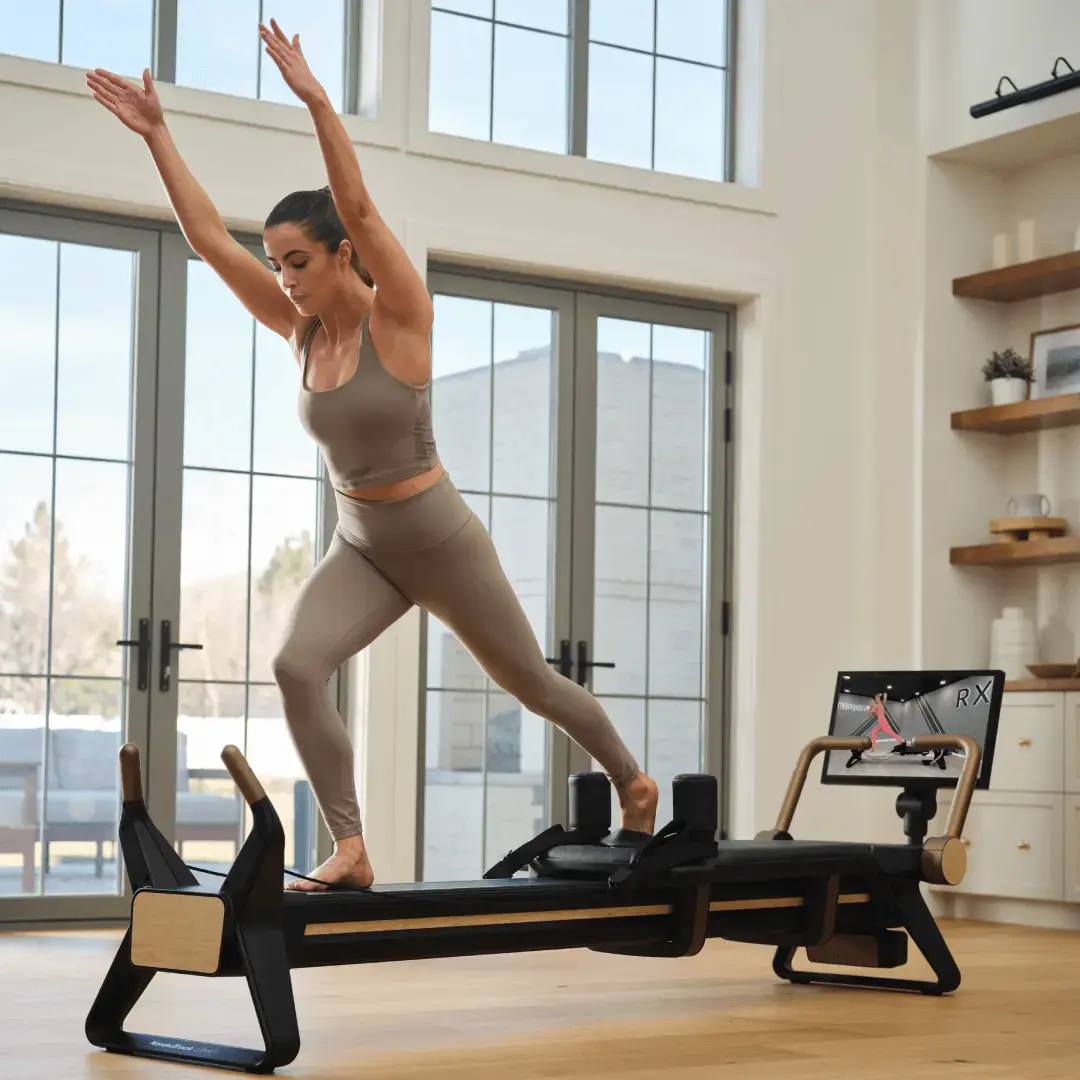
Table of contents
2. The history of Joseph Pilates
3. The six basic principles of Pilates
4. What are the benefits of Pilates?
5. Pilates and weight loss
6. Pilates or yoga – what are the differences?
9. Reformer Pilates vs. mat Pilates
10. Who is a Pilates reformer suitable for?
11. Is a Pilates reformer worth it for the home?
12. How much does a Pilates reformer cost?
13. When do you see the first results?
14. The most common beginner mistakes
15. Frequently asked questions (FAQ)
What is Pilates?
Welcome to the FITVYR® Pilates guide!
Pilates is now one of the most popular training methods in the world. Whether top athletes, entrepreneurs, actors, physiotherapists or senior citizens – millions of people use Pilates to improve their posture, reduce pain, build muscle and increase their overall performance.
Contrary to what many people assume, however, Pilates is by no means just a stretching programme or a gentle workout for women. Pilates is a systematic full-body workout that aims to improve strength, stability, mobility, coordination and body control at the same time.
At its centre is the so-called “Powerhouse”. This term describes the deep core muscles, which include the abdomen, back, pelvic floor and hips. While many classic forms of training focus mainly on visible muscles, Pilates concentrates on the muscle groups that are responsible for posture, stability and healthy movement patterns.
It is precisely this approach that makes Pilates interesting for people of all ages. From office workers with back pain to ambitious golfers and competitive athletes, a wide range of target groups benefit from the positive effects of this training method.
The history of Joseph Pilates
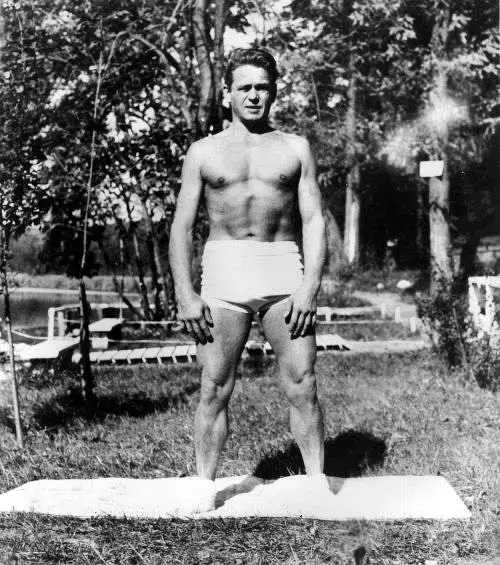
The inventor of Pilates training was Joseph Hubertus Pilates, who was born in Germany in 1883.
As a child, Joseph Pilates suffered from various health problems, including asthma, rickets and rheumatic fever. Instead of accepting these limitations, he began to study the anatomy of the human body intensively and developed his own training methods to improve his physical performance.
During the First World War, Pilates worked with injured soldiers in England. To support their rehabilitation, he developed his first training equipment. Some of these constructions are now regarded as forerunners of modern Pilates reformers.
After emigrating to the USA, Joseph Pilates opened a studio in New York together with his wife Clara. There, dancers, actors and athletes trained according to his method. Even then, Pilates was regarded as an effective tool for injury prevention and improving performance.
Although Joseph Pilates died in 1967, his training method is now experiencing a real boom. Modern technologies such as digital reformers, virtual training platforms and biomechanical analyses have developed his original ideas further and made them accessible to a new generation.
The six basic principles of Pilates
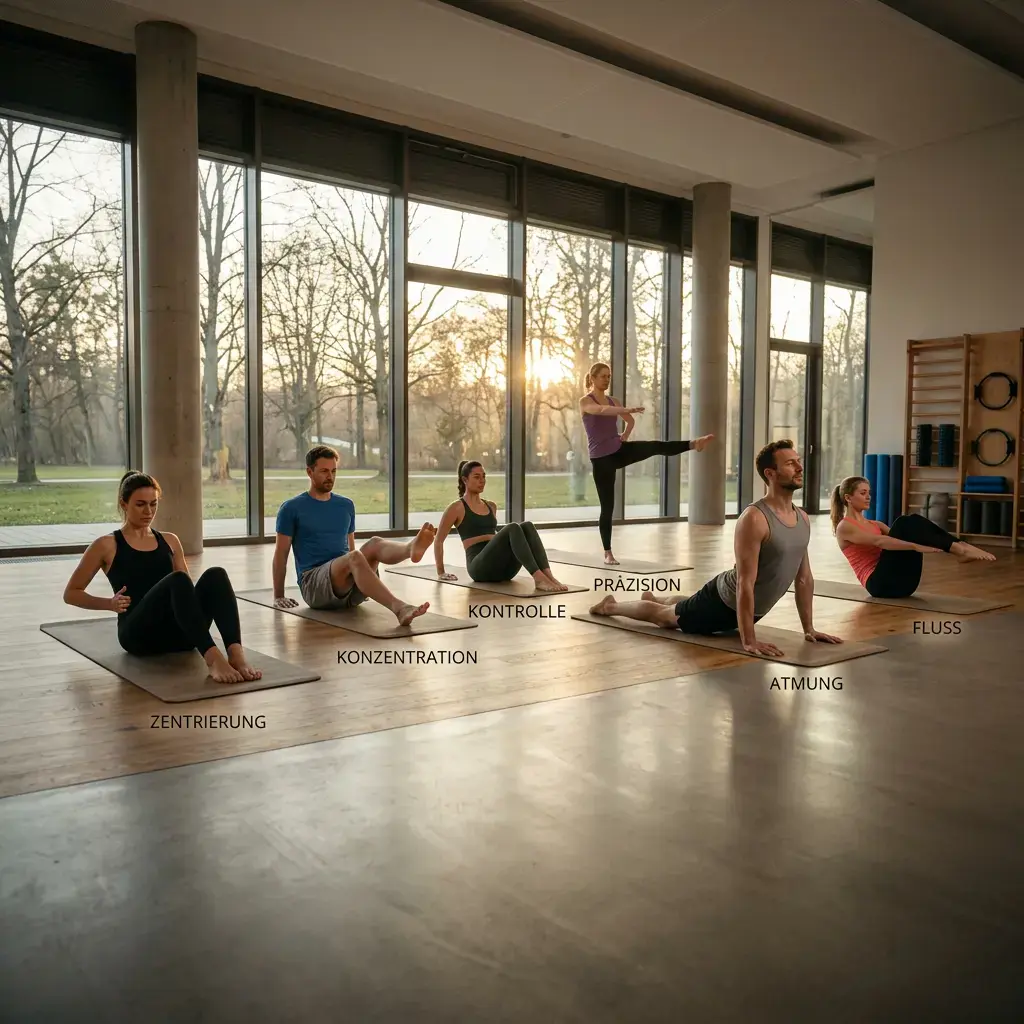
Pilates is not simply a collection of exercises. The method is based on six central principles.
Concentration
Every movement is performed consciously. The aim is to strengthen the connection between mind and body and to perform movements in a controlled rather than automatic way.
Control
Joseph Pilates originally called his method “Contrology”. Every movement should be precisely controlled instead of being performed with swing or momentum.
Centring
All movements begin in the so-called Powerhouse. The core forms the foundation of every exercise.
Precision
It is not the number of repetitions that determines training success, but the quality of execution.
Breathing
Breathing plays a central role. It supports the activation of the deep muscles and improves the body's oxygen supply.
Flow of movement
Pilates exercises should flow smoothly into one another. This creates a harmonious training experience that is gentle on the joints.
What are the benefits of Pilates?
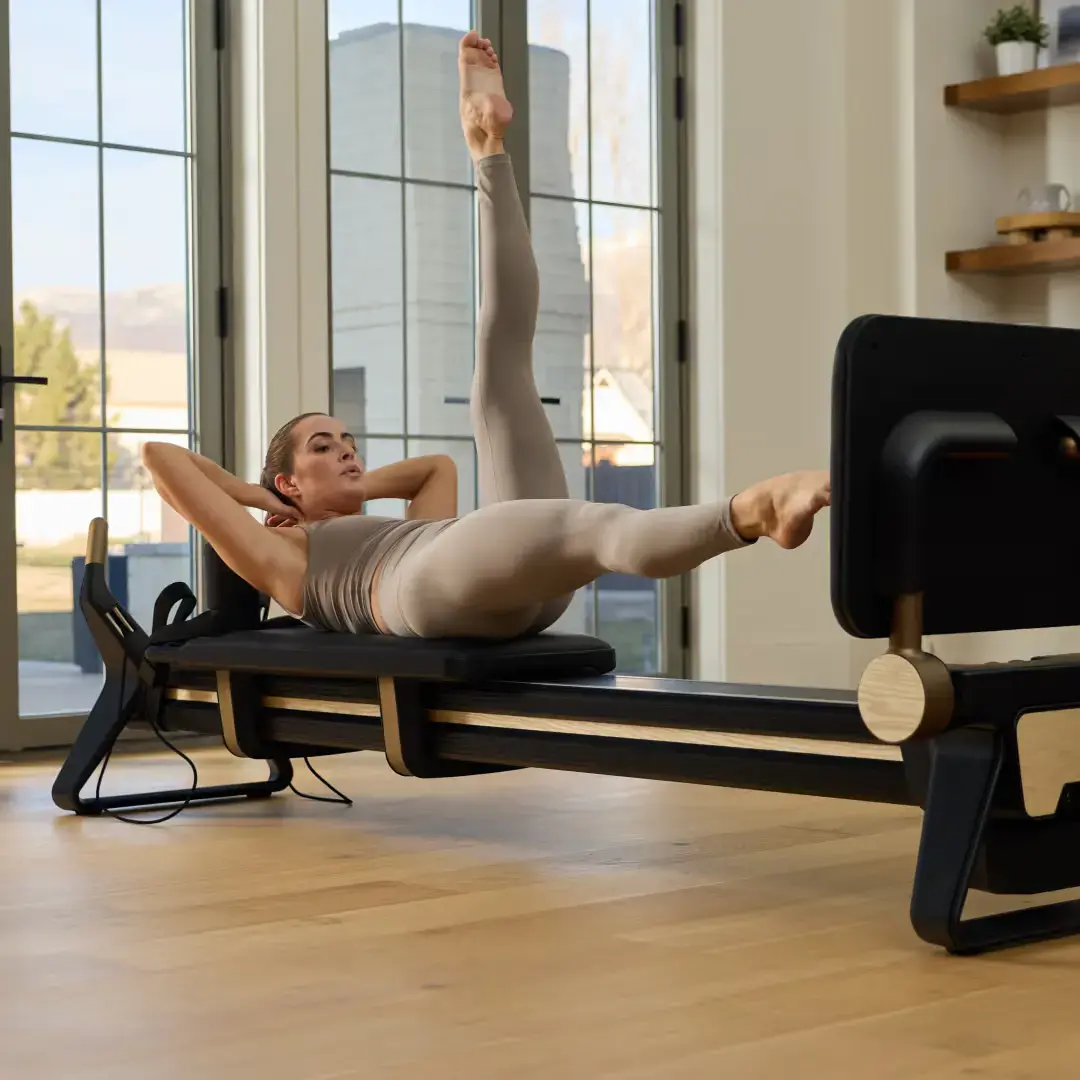
The growing popularity of Pilates is no coincidence. Hardly any other training method combines so many health benefits.
Improved posture
Many people spend several hours a day sitting at a computer. This often leads to a rounded back, shoulder problems and tension.
Pilates specifically strengthens the muscle groups that are responsible for an upright posture. After just a few weeks, many participants report an improved sense of their body.
Strengthening the core muscles
A strong core is the basis of almost all movements in everyday life and sport.
Pilates trains:
- Straight abdominal muscles
- Oblique abdominal muscles
- Deep abdominal muscles
- Back extensors
- Pelvic floor
- Hip stabilisers
Improved mobility
Unlike pure strength training, Pilates always pays attention to the full range of motion. This leads to a lasting improvement in joint mobility.
Joint-friendly training
Many exercises are performed lying down or sitting. As a result, the joints are put under much less strain than, for example, when running or jumping.
Support for back pain
Studies and practical experience show that Pilates can be helpful, particularly for non-specific back pain. Strengthening the core muscles reduces incorrect loading and stabilises the spine.
Improved body awareness
An often underestimated benefit is an increased awareness of your own body. Many people consciously learn for the first time how they move, sit or stand.
Can you lose weight with Pilates?
One of the most common questions is:
“Can you lose weight with Pilates?”
The answer is: yes, but not in the same way as with classic endurance training.
While jogging or cycling mainly burn calories, Pilates takes a different approach.
Pilates improves:
- Muscle mass
- Posture
- Metabolic activity
- Quality of movement
- Basal metabolic rate
By building active muscle mass, the body's daily energy consumption increases in the long term.
In addition, Pilates often improves body awareness. As a result, many people automatically develop healthier eating and exercise habits.
If you want to reduce your body weight, you should combine Pilates with a balanced diet. The best results come from a combination of strength training, Pilates, everyday activity and an adapted diet.
Pilates or yoga – what are the differences?
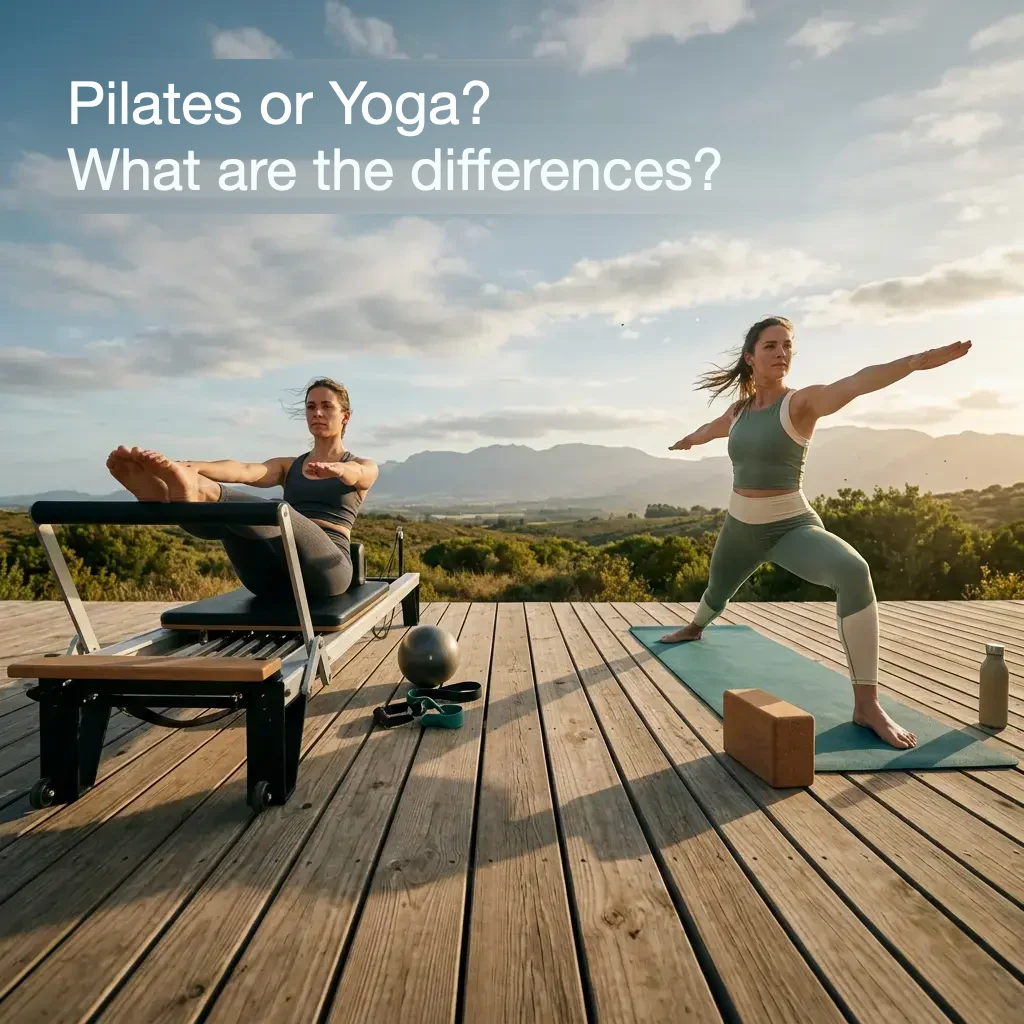
Pilates and yoga are often compared with each other. Although both forms of training have some things in common, they pursue different goals.
Yoga has its roots in an Indian philosophy that is thousands of years old. In addition to physical exercises, meditation and spirituality play an important role.
Pilates, on the other hand, was developed specifically as a training and rehabilitation system.
Typical differences:
Yoga:
- Focus on flexibility
- Meditation
- Relaxation
- Spiritual elements
Pilates:
- Focus on stability
- Building strength
- Posture
- Functional movement
Many people successfully combine both methods.
Yoga often improves flexibility and mental relaxation, while Pilates strengthens functional strength and body control.
Is Pilates only for women?
Hardly any prejudice is as persistent as the assumption that Pilates is exclusively a workout for women. In fact, the inventor Joseph Pilates was himself a boxer, gymnast, skier and keen athlete.
The original target group of his training method was by no means women, but people who wanted to improve their physical performance.
Today, numerous professional athletes use Pilates as an integral part of their training programme. These include:
- Footballers
- Golfers
- Tennis players
- Martial artists
- Runners
- Triathletes
- Ice hockey players
- Basketball players
Especially in competitive sport, it has been recognised that pure muscle strength is only part of the equation. Equally important are:
- Stability
- Mobility
- Coordination
- Injury prevention
- Body control
This is exactly where Pilates plays to its greatest strengths.
For golfers, for example, improved core stability can lead to more control in the swing. Martial artists benefit from greater mobility and better body control. Strength athletes often use Pilates to correct muscular imbalances.
The idea that Pilates is only suitable for women is therefore long outdated.
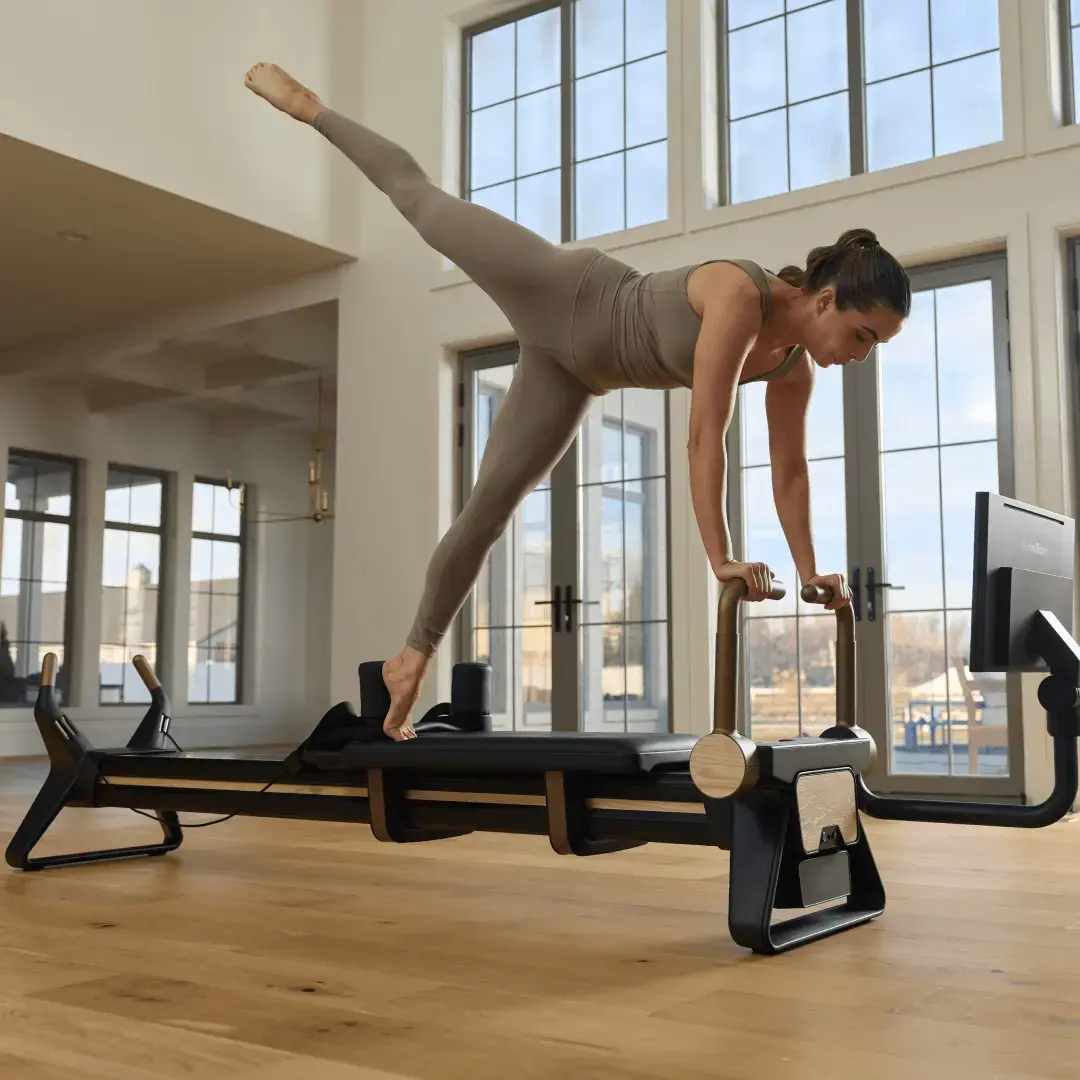
What is Reformer Pilates?
While many people initially think of exercises on a mat when it comes to Pilates, this is merely one variant of the training.
The so-called reformer was already part of the original Pilates method and was developed by Joseph Pilates himself.
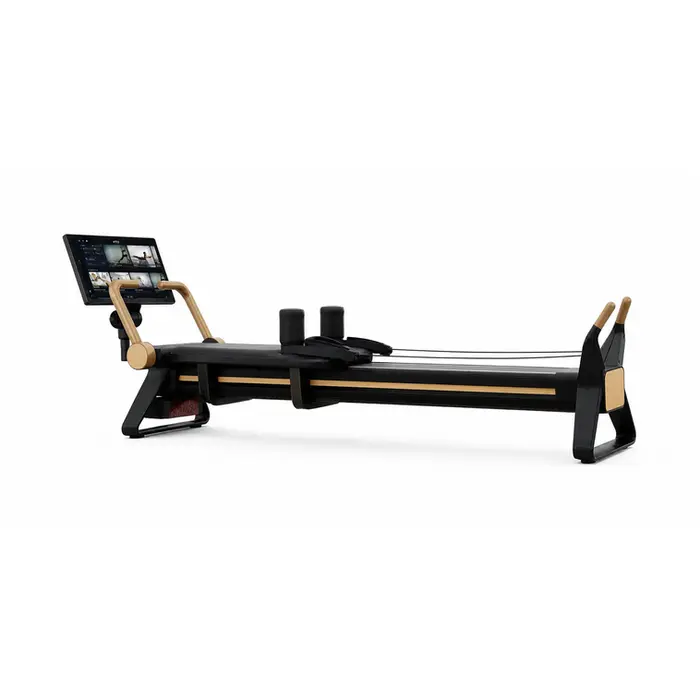
A Pilates reformer essentially consists of:
- a stable frame
- a moving carriage
- resistance systems
- cables
- handles
- shoulder rests
- a footbar
The user moves the carriage in a controlled manner against a defined resistance.
This results in numerous advantages:
- controlled movements
- joint-friendly training
- precise load control
- a wide variety of exercises
- full-body training
Modern reformers such as the NordicTrack Ultra 1 add digital functions to this concept, such as touchscreens, training statistics and guided training programmes.
How does a Pilates reformer work?
The basic principle is surprisingly simple.
The carriage moves along a frame. Ropes, pulleys and resistances make a wide range of exercises possible.
Depending on the exercise, the user can:
- push
- pull
- rotate
- stabilise
- balance
This trains not only the visible muscle groups but also the deep muscles.
A decisive advantage is that the resistances can be dosed very precisely. This makes Reformer Pilates suitable for both beginners and experienced athletes.
Which muscle groups does Reformer Pilates train?
One of the biggest advantages of a reformer is that almost every muscle group can be trained.
These include:
Abdominal muscles
- Rectus abdominis
- Oblique abdominal muscles
- Deep core muscles
Back
- Back extensors
- Upper back
- Shoulder blade stabilisers
Legs
- Quadriceps
- Hamstrings
- Calves
Glutes
- Gluteus maximus
- Gluteus medius
- Gluteus minimus
Upper body
- Chest
- Shoulders
- Biceps
- Triceps
Pelvic floor
Particularly interesting for people after injuries, pregnancies or longer breaks from training.
Reformer Pilates vs. mat Pilates
Many beginners wonder which option is the better choice.
The answer depends on the individual goal.
Criterion | Reformer Pilates | Mat Pilates |
Muscle building | Very good | Good |
Resistance training | Yes | Hardly any |
Variety of exercises | Very high | High |
Gentle on the joints | Very high | High |
Training control | Very precise | Limited |
Suitability for beginners | Very high | Medium |
Motivation | High | Individual |
Mat Pilates has the advantage that almost no equipment is needed.
Reformer Pilates, on the other hand, offers considerably more training options and allows much more precise control of the load.
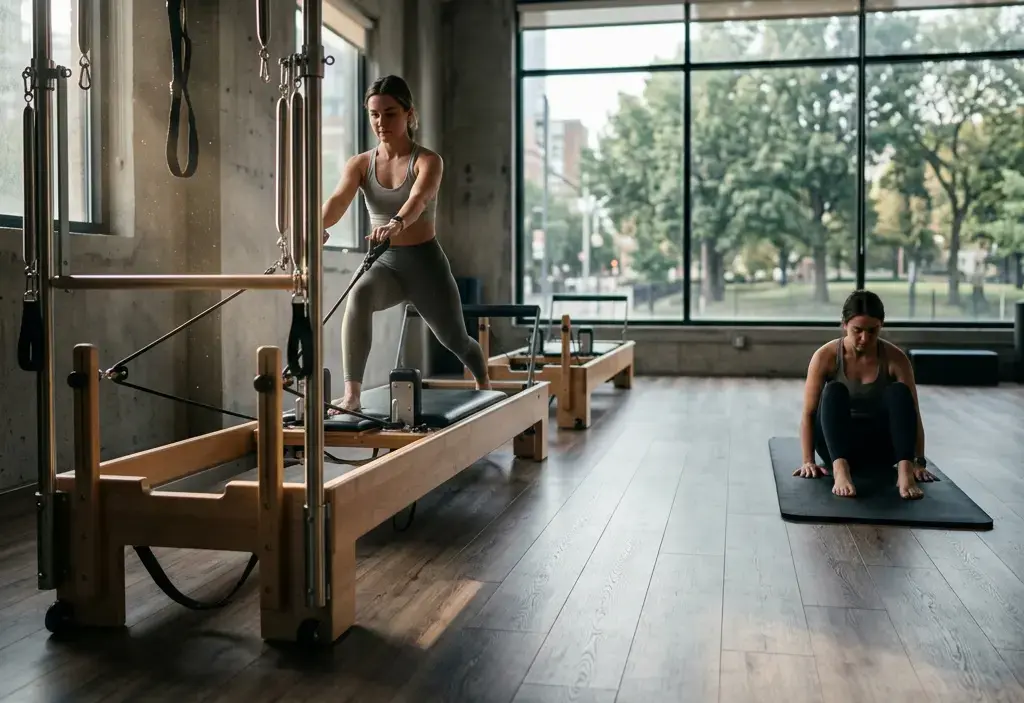
Is Reformer Pilates better than mat Pilates?
This question is asked frequently, but there is no one-size-fits-all answer.
For many people, however, Reformer Pilates is the more effective option, because:
- more resistance can be used
- more muscle groups are trained at the same time
- exercises can be adapted more easily
- beginners make progress faster
People with back problems or limited mobility in particular often benefit from the reformer.
Feel free to share your opinion with us and let us know where you stand:
Reformer or mat Pilates?
0%Reformer Pilates
0%Mat Pilates
Who is Reformer Pilates suitable for?
The short answer is:
Almost everyone.
Beginners
Thanks to the guided movements, getting started is easier than with many traditional forms of training.
Seniors
The joint-friendly movements and controlled loads make Reformer Pilates attractive in later life too.
Athletes
Many athletes use Reformer Pilates to improve performance and prevent injuries.
People with back problems
By strengthening the deep muscles, Pilates can help to stabilise the spine.
People in sedentary jobs
Anyone who spends many hours at a desk every day benefits in particular from improved posture and mobility.
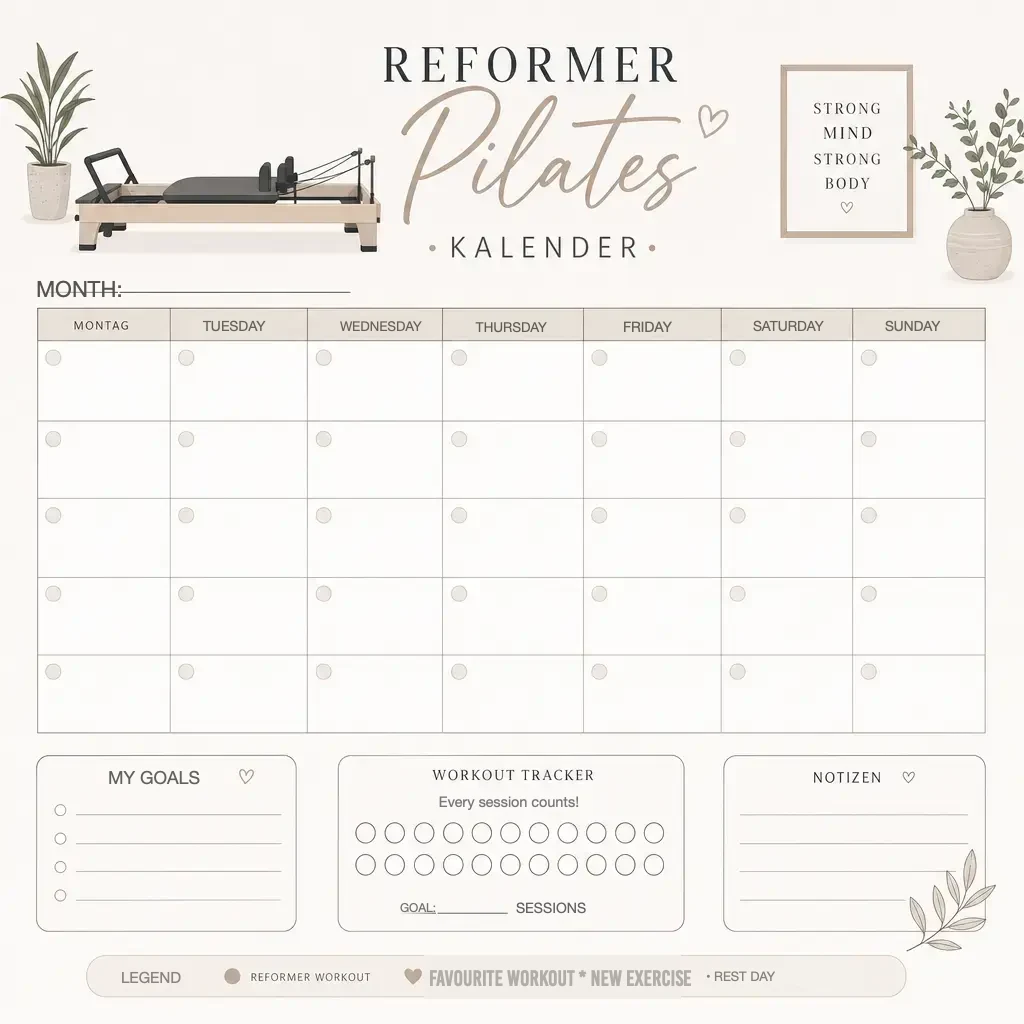
How often should you do Reformer Pilates?
The optimal training frequency depends on your personal goal.
Beginners
2 to 3 sessions per week
Advanced
3 to 5 sessions per week
Performance-oriented users
5 to 7 sessions per week
Unlike many traditional strength training programmes, Pilates puts comparatively little strain on the joints. This makes more frequent sessions possible.
When will you see the first results?
Joseph Pilates is reported to have once said:
“After 10 hours you will feel the difference. After 20 hours you will see the difference. After 30 hours you will have a new body.”
Although this statement is of course simplified, many users report the following after just a few weeks:
- better posture
- less tension
- a stronger core
- improved mobility
After around 8 to 12 weeks, visible physical changes often become noticeable as well.
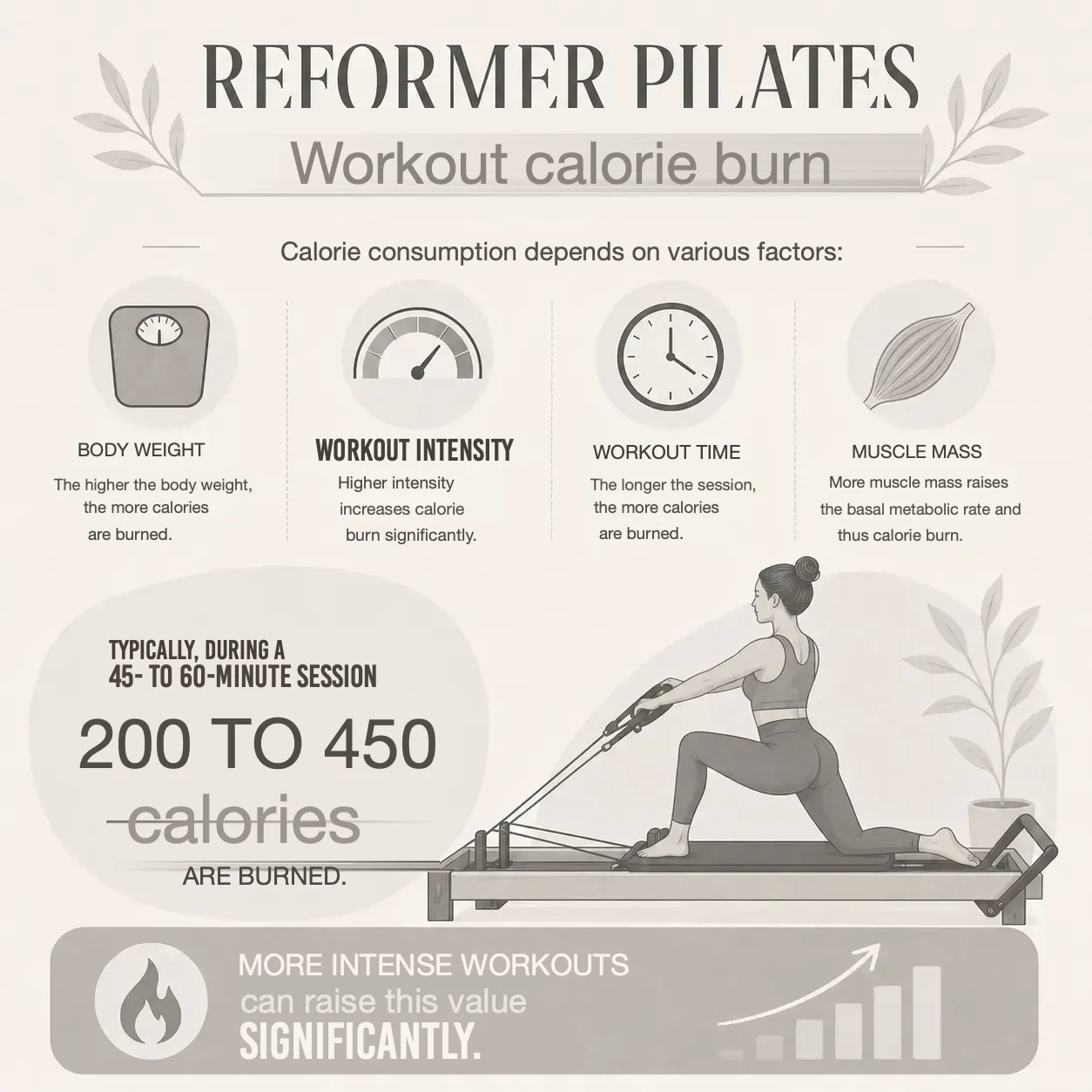
How many calories does Reformer Pilates burn?
Calorie consumption depends on various factors:
- Body weight
- Training intensity
- Training duration
- Muscle mass
In a typical 45- to 60-minute session, approximately:
- 200 to 450 calories
are burned.
More intense workouts can increase this figure considerably.
However, Pilates should not be judged solely on calorie consumption. The long-term effects on muscle building, posture and metabolism are often much more important.
Is a Pilates reformer for home worth it?
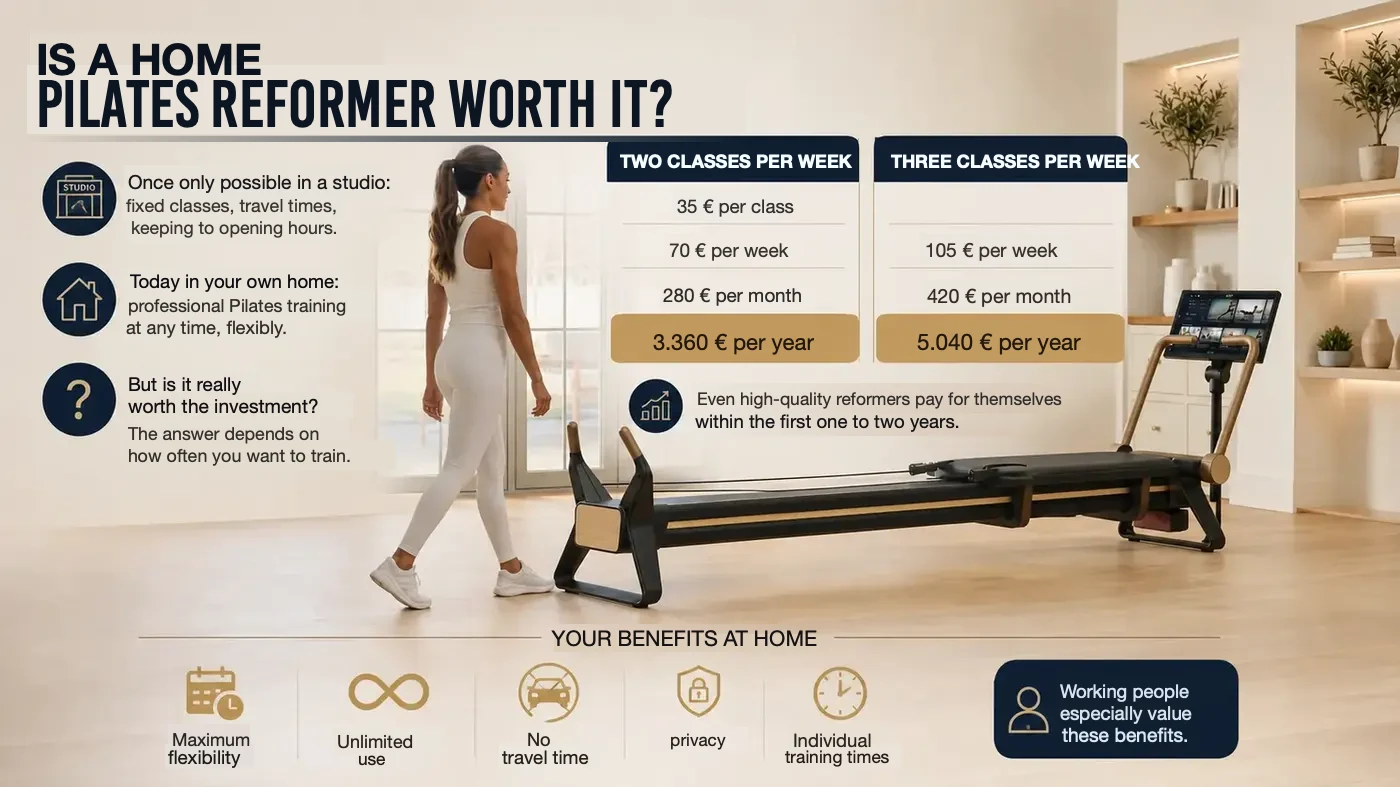
Just a few years ago, Reformer Pilates was available almost exclusively in specialised Pilates studios. If you wanted to train regularly, you had to book fixed classes, put up with travel time and adapt to a studio’s opening hours.
Today, this market is changing fundamentally.
Modern home reformers make it possible to do professional Pilates training at any time in your own home.
But is the investment really worth it?
The answer depends on how often you want to train.
Let’s look at a typical example:
Two reformer classes per week:
€35 per class
€70 per week
€280 per month
€3,360 per year
Three classes per week:
€105 per week
€420 per month
€5,040 per year
As a result, even high-quality reformers often pay for themselves within the first one to two years.
Users also benefit from:
maximum flexibility
unlimited use
no travel time
privacy
individual training times
Working people in particular greatly appreciate these advantages.
What types of Pilates reformers are there?
The market for Pilates reformers is growing rapidly. However, the devices sometimes differ considerably.
Broadly speaking, there are three categories.
Entry-level reformers
Price range:
€500 to €1,500
Typical features:
simple frame
few adjustment options
limited load capacity
often foldable
Suitable for:
occasional users
beginners on a small budget
Disadvantages:
limited variety of exercises
shorter service life
often less stable
Premium reformers
Price range:
€1,500 to €5,000
Typical features:
high-quality materials
smoother, quieter running
more precise resistance
more adjustment options
Suitable for:
regular users
ambitious home exercisers
Commercial reformers
Price range:
€3,000 to €10,000 and more
Typical features:
maximum load capacity
studio standard
designed for continuous operation
highest material quality
Suitable for:
Pilates studios
Personal trainers
Hotels
physiotherapy practices
professional users
Why are some Pilates reformers so expensive?
This question is asked particularly often.
At first glance, many reformers look similar. However, the differences usually lie in the details.
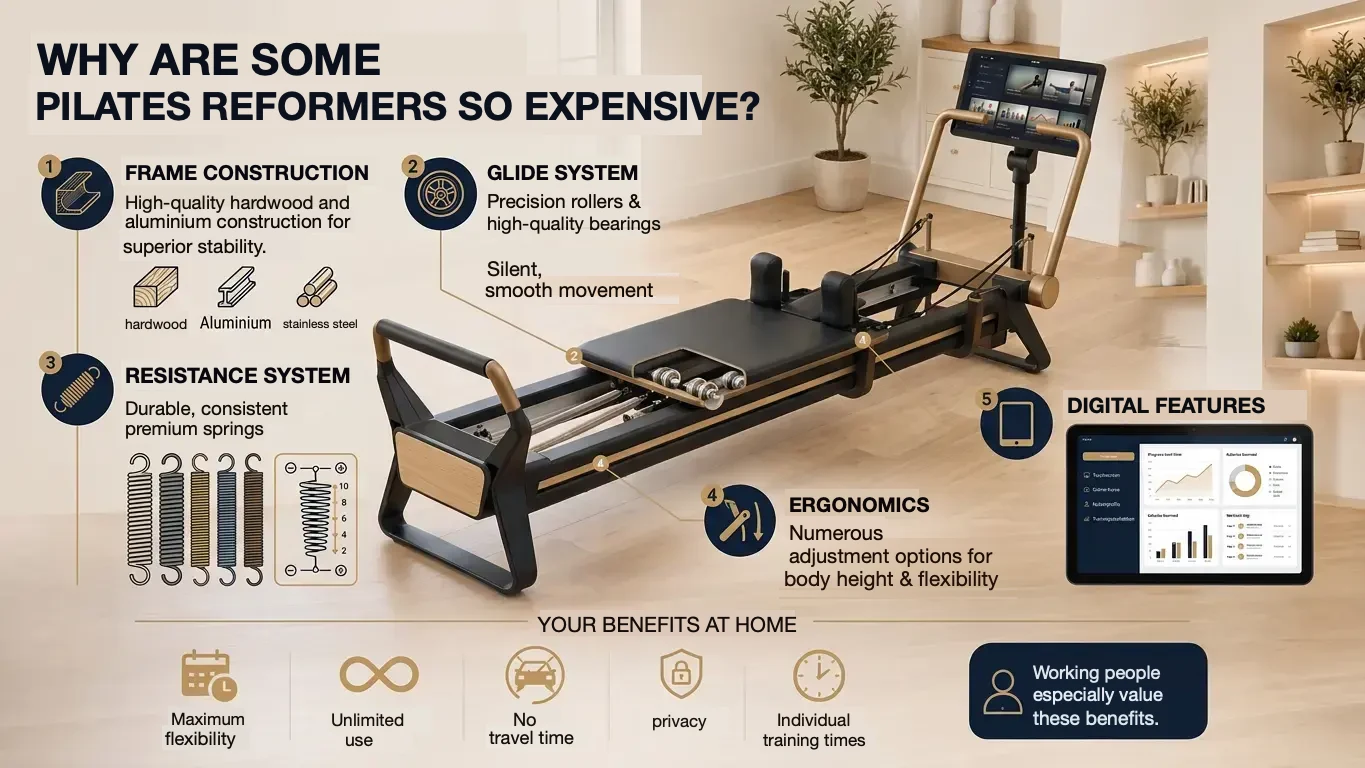
The most important factors include:
Frame construction
High-quality reformers use:
aluminium
stainless steel
hardwood
reinforced composite materials
Cheaper models often rely on simpler constructions.
Glide system
A high-quality carriage moves almost silently and without jerking.
This requires:
precision rollers
high-quality bearings
exact manufacturing tolerances
Resistance system
The quality of the springs and resistance affects the entire training feel.
This is often where the biggest differences between cheap and high-quality devices become apparent.
Ergonomics
Professional reformers offer numerous adjustment options for:
body height
flexibility
training level
Digital features
Modern premium reformers increasingly integrate:
touchscreens
online classes
training statistics
User profiles
performance analyses
The evolution from the classic reformer to the smart reformer
Pilates is currently going through a similar development to the one fitness equipment went through a few years ago.
In the past, treadmills consisted merely of a motor, belt and display.
Today, modern treadmills feature:
virtual routes
coaching
training analyses
app connectivity
Exactly this development is now also taking place in Pilates.
The next generation of reformers combines classic Pilates principles with modern technology.
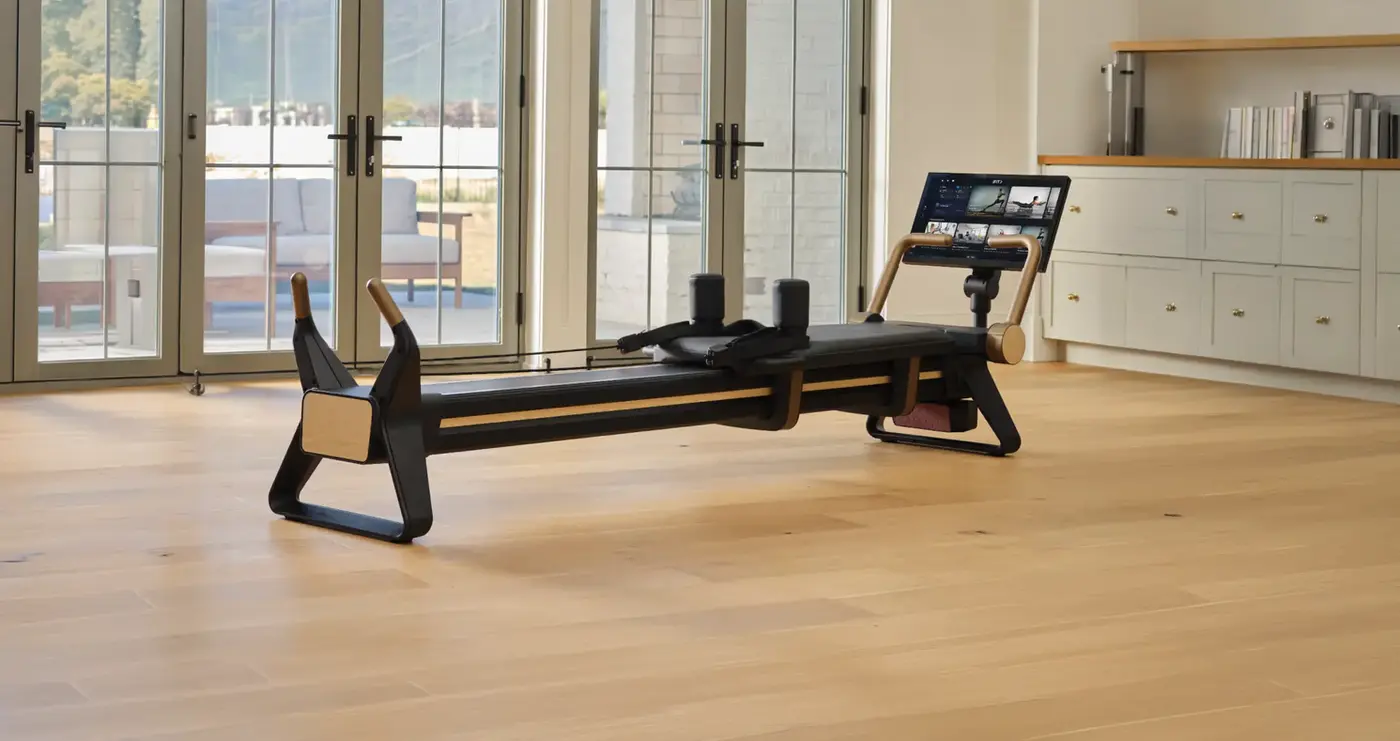
What is a smart reformer?
A smart reformer combines a classic Pilates reformer with digital features.
These can include:
Touchscreen
online classes
training programmes
progress tracking
performance data
User profiles
This creates a much more interactive training experience.
Beginners in particular benefit from the guided workouts.
NordicTrack Ultra 1 – a new generation of reformers
The NordicTrack Ultra 1 is one of the most technologically advanced reformers in its class.
Unlike classic reformers, it features:
an integrated touchscreen
iFIT connectivity
Smart Spine™ Tracking
digital training evaluation
This gives users immediate feedback during training.
The most important features include:
resistance from 10 to 45 kg
enclosed spring design
four-way adjustable split footbar
Smart Spine™ Tracking
iFIT integration
guided training programmes
The Ultra 1 is aimed primarily at demanding home users who are looking for a professional Pilates experience at home.
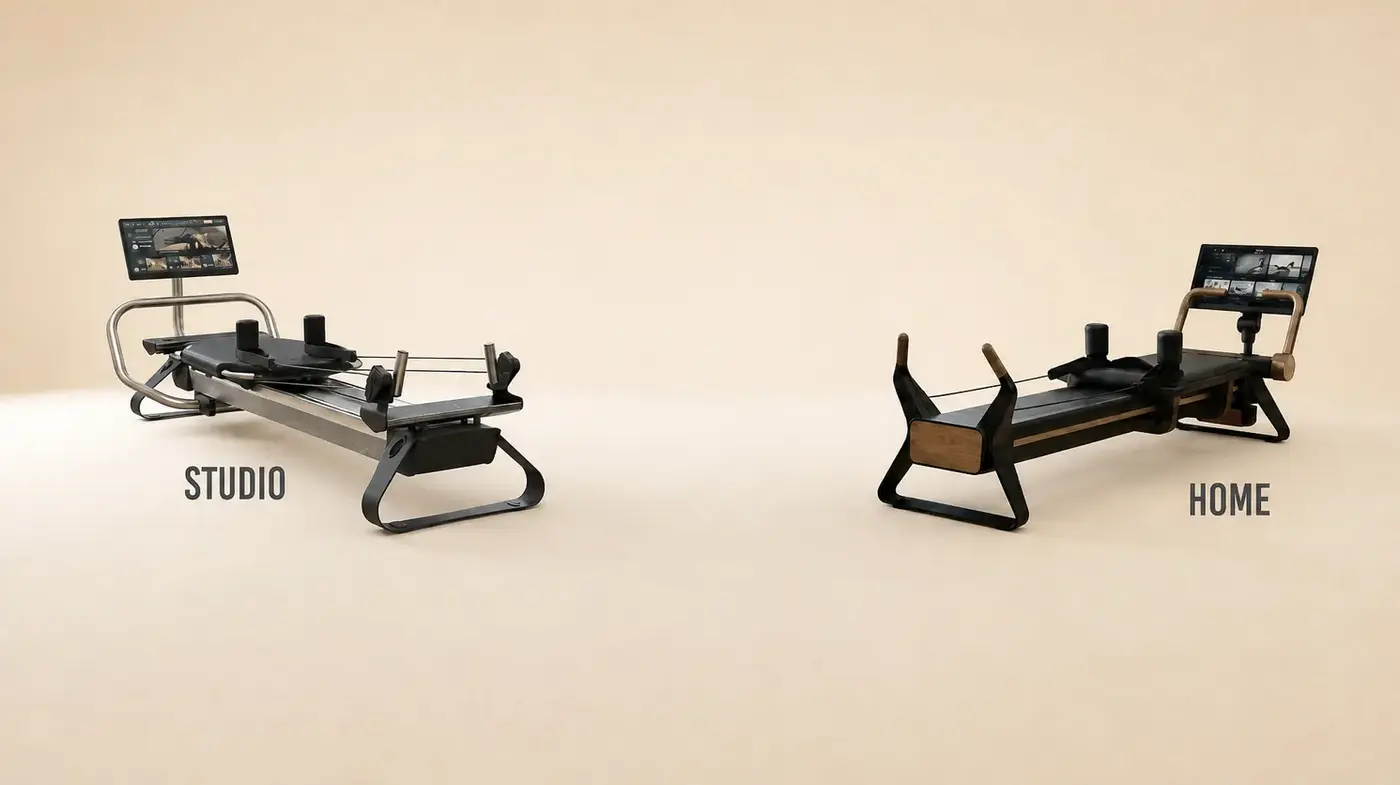
NordicTrack Ultra 1 Reformer vs. Ultra 1 Reform RX-S
Although both devices belong to the same product family, they are aimed at different target groups.
NordicTrack Ultra 1 Reformer
Ideal for:
private households
home gyms
Beginners
advanced users
 NordicTrackNordicTrack Ultra 1 Reformer€7,990 incl. VAT
Advantages:
more compact
better suited to living spaces
easy to get started
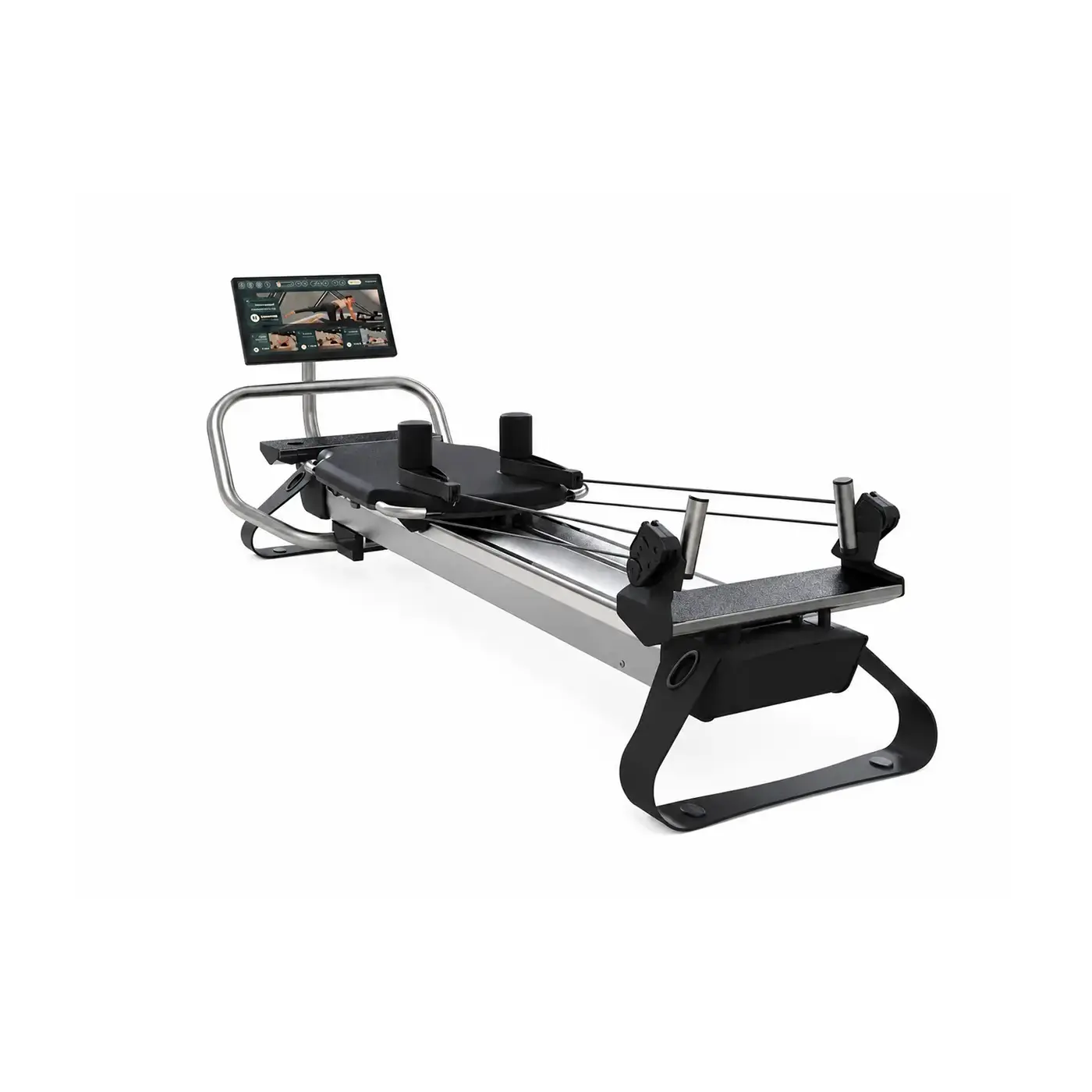
NordicTrack Ultra 1 Reformer RX-S
Ideal for:
Studios
Hotels
physiotherapy practices
Personal trainers
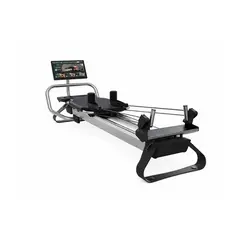 NordicTrackNordicTrack Reformer RX-SFor business customers at FITVYR® Pro
Advantages:
higher load capacity
professional continuous use
studio environment
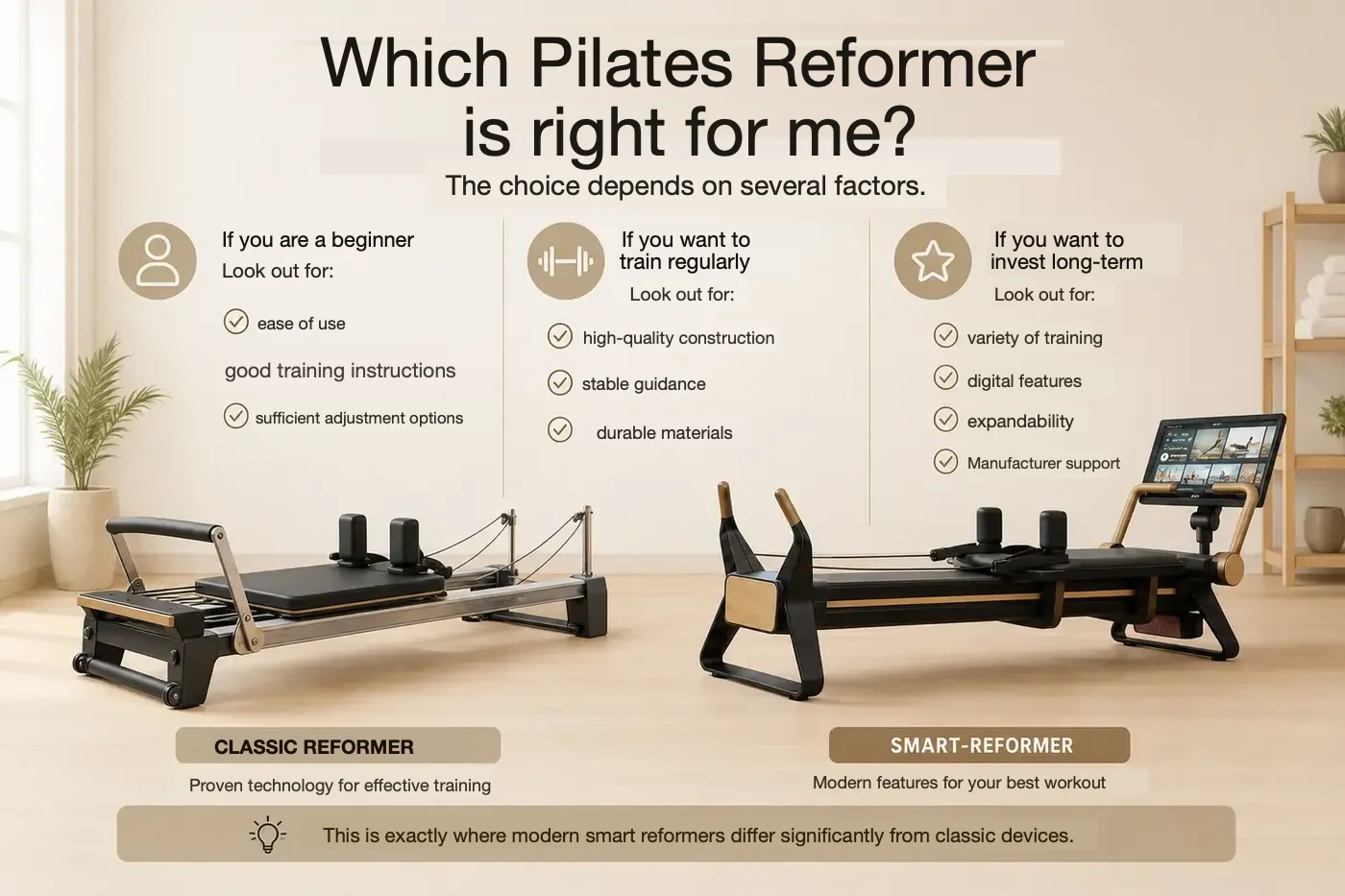
Which Pilates reformer is right for me?
The choice depends on several factors.
If you are a beginner
Look out for:
ease of use
good training instructions
sufficient adjustment options
If you want to train regularly
Look out for:
high-quality construction
stable guidance
durable materials
If you want to invest for the long term
Look out for:
variety of training
digital features
expandability
manufacturer support
This is exactly where modern smart reformers differ significantly from classic devices.
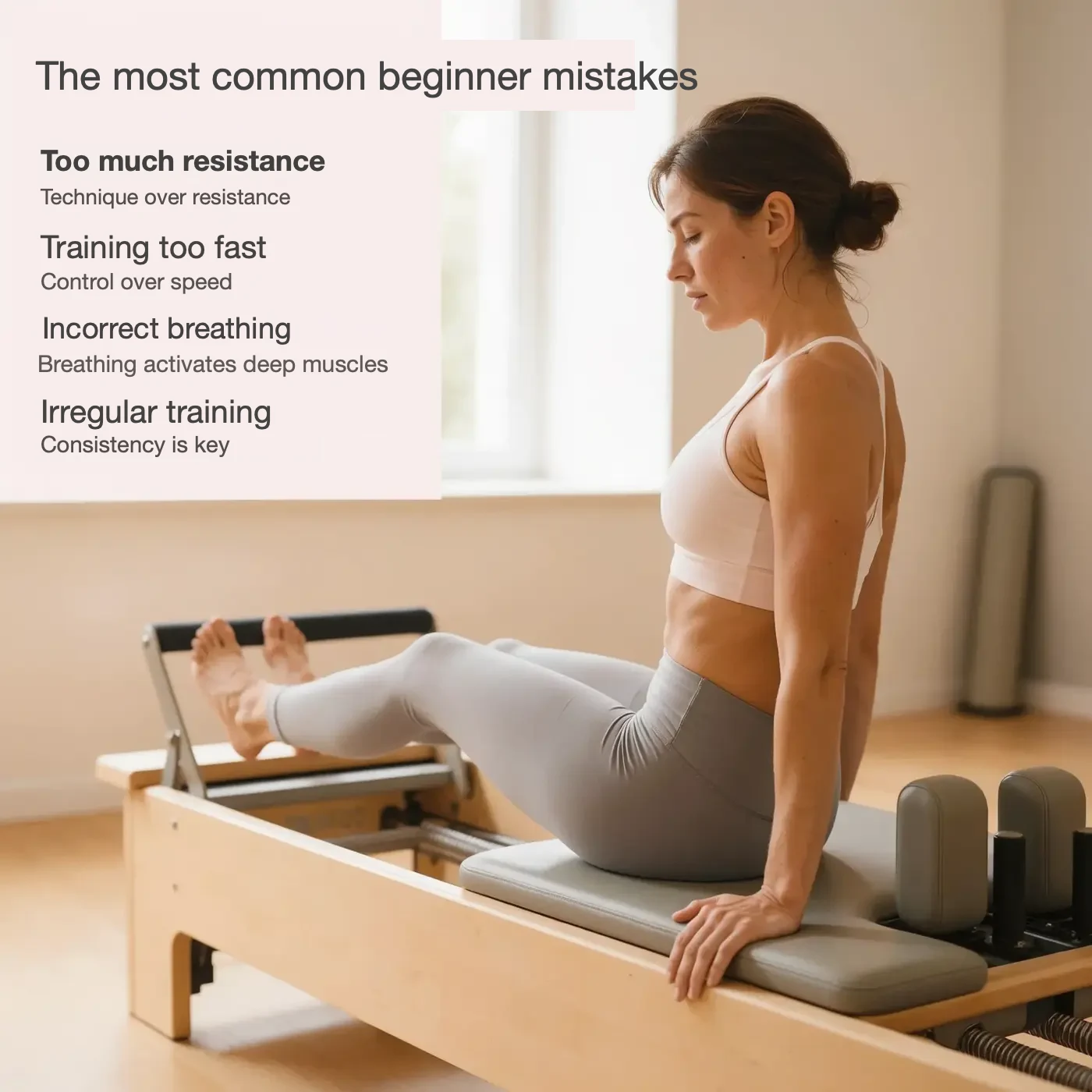
The most common beginner mistakes
Too much resistance
More resistance does not automatically mean better results.
Technique should always take priority.
Training too fast
Pilates is all about control.
Slow movements are often much more effective than fast repetitions.
Incorrect breathing
Breathing supports the activation of the deep muscles.
Many beginners underestimate this aspect.
Irregular training
The biggest success factor remains consistency.
Two regular sessions per week are much more effective than sporadic intensive phases.
Conclusion
Pilates is one of the most effective training methods for people who want to improve strength, flexibility, stability and body control at the same time.
Reformer Pilates in particular considerably expands the possibilities of classic mat Pilates. Thanks to the combination of resistance training, controlled movements and joint-friendly loading, this form of training is suitable for almost every age and fitness level.
Modern smart reformers such as the NordicTrack Ultra 1 take this development consistently further. They combine the proven principles of Joseph Pilates with digital coaching, training analyses and interactive programmes.
If you want to do Pilates regularly, a high-quality reformer can not only save you time in the long run, but often also significantly reduce the cost of regular studio visits.
However, what matters most is not the device itself, but how regularly you train. Just a few sessions per week can help to improve posture, flexibility, strength and well-being in the long term.
FAQ (frequently asked questions)
What is Pilates?
Pilates is a full-body workout that improves strength, flexibility, stability, posture and coordination. The focus is on activating the deep core muscles, known as the powerhouse.
Who invented Pilates?
Pilates was developed by Joseph Hubertus Pilates. The German developed his training method at the beginning of the 20th century and initially used it for rehabilitation and performance enhancement.
Is Pilates suitable for beginners?
Yes. Pilates is very well suited to beginners, as intensity and difficulty can be adjusted individually.
Is Pilates only for women?
No. Pilates was originally developed by a man and today is used equally by men and women. Many professional athletes make Pilates a fixed part of their training.
Is Pilates also suitable for seniors?
Yes. Thanks to the controlled movements and the low strain on the joints, Pilates is very well suited to older people.
Can you lose weight with Pilates?
Pilates supports weight loss through muscle building, increased calorie consumption and an improved metabolism. The best results are achieved in combination with a balanced diet.
How many calories does Pilates burn?
Depending on intensity, body weight and training duration, around 200 to 450 calories are burned per hour.
Is Pilates strength training?
Yes. Pilates is a form of functional strength training that particularly trains the deep muscles.
Is Pilates cardio?
Pilates is primarily strength and stability training. However, more intense sessions can also increase the cardiovascular load.
Can Pilates relieve back pain?
Many people report an improvement in their back pain. Strengthening the core muscles stabilises the spine better.
What is the difference between Pilates and Reformer Pilates?
Classic Pilates is mostly done on a mat. Reformer Pilates additionally uses a movable carriage, resistance and cables.
Is Reformer Pilates better than mat Pilates?
Not necessarily better, but more versatile. Reformer Pilates allows more resistance, more exercise variations and more precise training control.
Is Reformer Pilates gentle on the joints?
Yes. The controlled movements and the option of doing exercises lying down or sitting make Reformer Pilates particularly gentle on the joints.
How often should you do Pilates?
Two to three sessions per week are recommended for beginners. Advanced users often train three to five times a week.
How often should you do Reformer Pilates?
Here too, two to five sessions per week are considered sensible, depending on training goal and experience.
When will you see the first results from Pilates?
Many people notice improvements in posture, flexibility and body awareness after just a few weeks. Visible changes often appear after eight to twelve weeks.
Do I need any previous experience for Reformer Pilates?
No. Modern reformers and guided training programmes make it much easier to get started.
Do I need to be flexible to do Pilates?
No. Many people start Pilates precisely to become more flexible.
What should I wear for Pilates?
Comfortable sportswear that allows enough freedom of movement is recommended. Loose clothing can make it harder to control your movements.
Do I need special socks for Pilates?
Not necessarily. However, many studios recommend non-slip Pilates socks for added safety.
Can I do Pilates at home?
Yes. Both mat Pilates and Reformer Pilates can easily be done at home.
Is a Pilates reformer for home worth it?
If you train regularly, a home reformer can save you time in the long run, and often money too, compared with regular studio visits.
How much space does a Pilates reformer need?
Depending on the model, around 2.5 to 3 metres in length and about 1 metre in width are usually recommended.
How much does a Pilates reformer cost?
Entry-level devices start at around 500 euros. High-quality premium and commercial models can cost several thousand euros.
Why are Pilates reformers so expensive?
High-quality reformers consist of precisely manufactured components, durable materials and complex resistance systems. Modern smart reformers also integrate digital technologies.
What is a smart reformer?
A smart reformer combines classic Pilates training with digital features such as a touchscreen, online classes, training analyses and progress tracking.
What is Smart Spine™ Tracking?
Smart Spine™ Tracking is a technology of the NordicTrack Ultra 1 that records training data such as output, movement frequency and calorie consumption in real time.
What is the difference between the NordicTrack Ultra 1 and the Ultra 1 RX-S?
The Ultra 1 was developed for demanding home users. The Ultra 1 RX-S is aimed at studios, hotels, personal trainers and other commercial users.
Is Reformer Pilates suitable for men?
Yes. More and more men are using Reformer Pilates to improve strength, flexibility, posture and athletic performance.
Can I do Pilates every day?
Yes. Because of the comparatively low strain on the joints, daily Pilates training is generally possible.
Can Pilates help build muscle?
Yes. Reformer Pilates in particular enables effective muscle building through variable resistance.
Is Pilates useful for golfers?
Yes. Pilates improves core stability, flexibility and body control – factors that can have a positive effect on your golf swing.
Can Pilates improve posture?
Yes. Strengthening the stabilising muscles is one of the biggest benefits of Pilates training.
What is the powerhouse in Pilates?
The powerhouse refers to the centre of the body. It includes the abdominal muscles, back, pelvic floor and hip muscles.
Is Pilates also suitable for people in sedentary jobs?
Yes. People who spend many hours at a desk every day in particular often benefit from Pilates.
Can Pilates improve flexibility?
Yes. Regular Pilates training improves the mobility of muscles and joints and can reduce restrictions in movement.
How did you like our Pilates guide?
So that we can continue to write useful blog articles, ratings help us a great deal to find out how our articles are received by our readers and whether we can make improvements where necessary.