Which smart home fitness systems are best suited to strength training? The biggest smart home gym comparison in 2026!
If you want to train effectively today, you no longer need an overcrowded gym. Smart home fitness systems enable professional training in the smallest of spaces – with digital resistance, AI-controlled adjustment and personalised training plans. But which system is really suitable for serious strength training? And which devices are worth their money?
In this detailed comparison, you will find out which smart fitness devices are currently among the best, what they can do and what you should look out for if you want to build strength and muscle in the long term.
What are smart home gyms?
A “smart home gym” is an intelligent fitness system that combines technology, sensors and digital resistance technology to make training at home as effective as possible. Instead of weights, it usually uses electronically controlled motors or magnetic resistance, which can be precisely regulated.
The result: individual, automatically adapting training that feels like real gym training – only smarter.
A smart home gym can:
analyse movements in real time,
detect errors in execution,
automatically adjust the resistance,
document progress,
and provide personalised training plans.
In short: it is your digital personal trainer and your gym in one device.
Why are smart home fitness systems particularly interesting for strength training?
Strength training thrives on progression, control and consistency. Conventional machines with weight stacks or free weights do provide real load, but hardly any feedback.
Smart systems, on the other hand, measure every millimetre of your movement, adjust the intensity dynamically and save your performance data automatically. This lets you evaluate your training objectively – and control your progress precisely.
The most important advantages for strength training:
Digital resistance up to 100 kg or more
Automatic progression and repetition analysis
Eccentric loading for maximum muscle growth
Safe training control without a spotter
Space saving – a complete gym on 0.1 m²
THE BIG COMPARISON
in detail
Slowly but surely, the smart home gym market is becoming quite confusing.
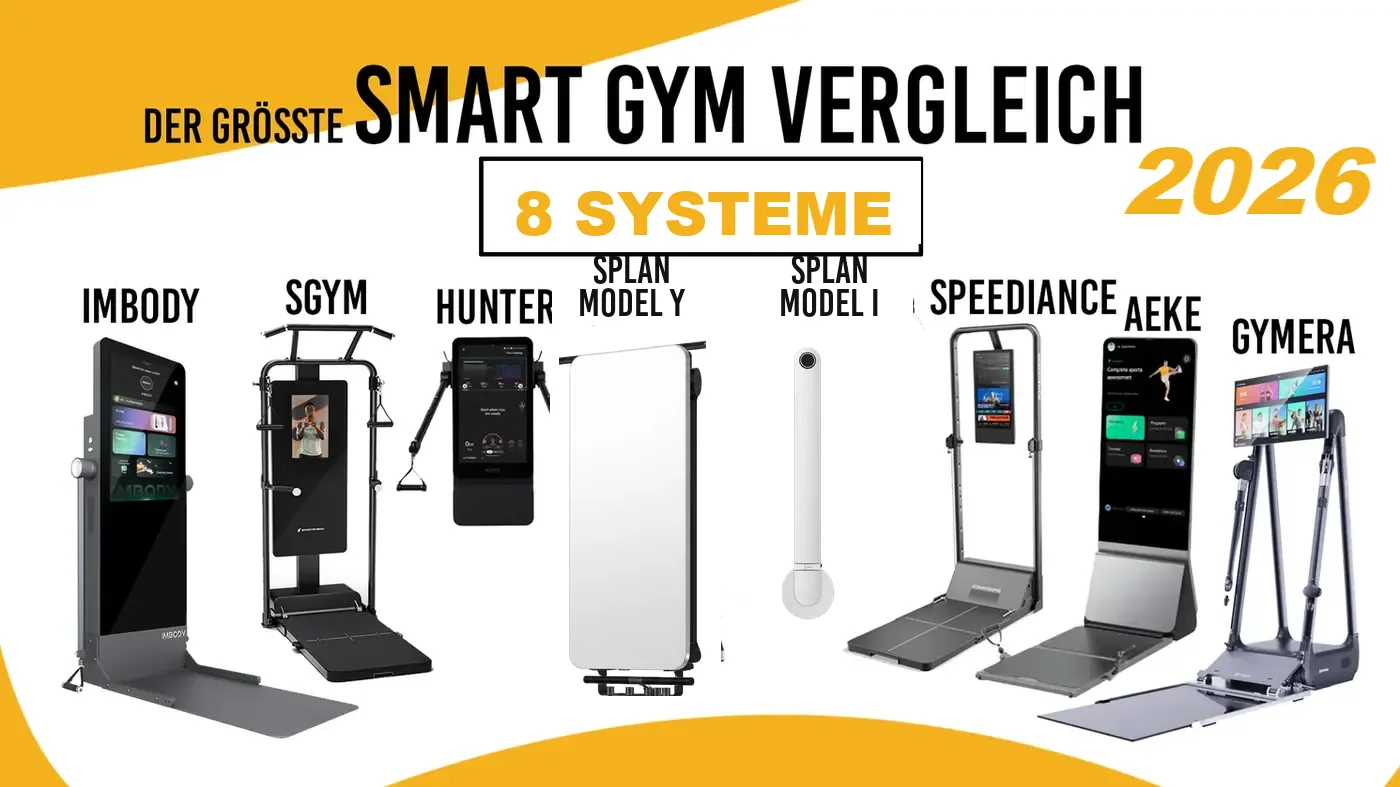
But because we at FITVYR® are not only the exclusive distributor of various brands, but also your neutral guide through the smart home jungle, today we are presenting all the smart home gym systems available in German-speaking countries and comparing them in the following categories:
1. Design – Can the smart home gym be integrated seamlessly into any home without looking out of place?
2. Space requirements – How much space does the smart home gym take up?
3. Set-up – Permanently installed, freestanding or roll-away?
4. Resistance – How much maximum resistance is possible and what does that mean for durability?
5. Training quality – What is the overall training feel like?
Translation, stability, exercise options, training modes, Bluetooth & voice control, class offering & subscriptions
6. Accessories – Which accessories are available?
7. Other features – what special features make the smart home gym unique?
8. Costs – How high are the costs of the smart home gym?
9. Customer service – Who is responsible if problems occur or repairs are needed? How easy is it to replace spare parts?
10. Future – How stable is the company? Will the brand still be around in a few years?
Let’s go.
Category 1 – Design
When it comes to whether the smart home gym can be integrated seamlessly into your home without looking out of place like conventional home gym equipment,
3 candidates stand out right away – though negatively. Because of the way they are built, the Speediance Gym Monster, the Gymera and the Sportstech sGym are simply not particularly attractive to look at. The Gymera does score points, however, in that it is a stylish design object at least when folded up.
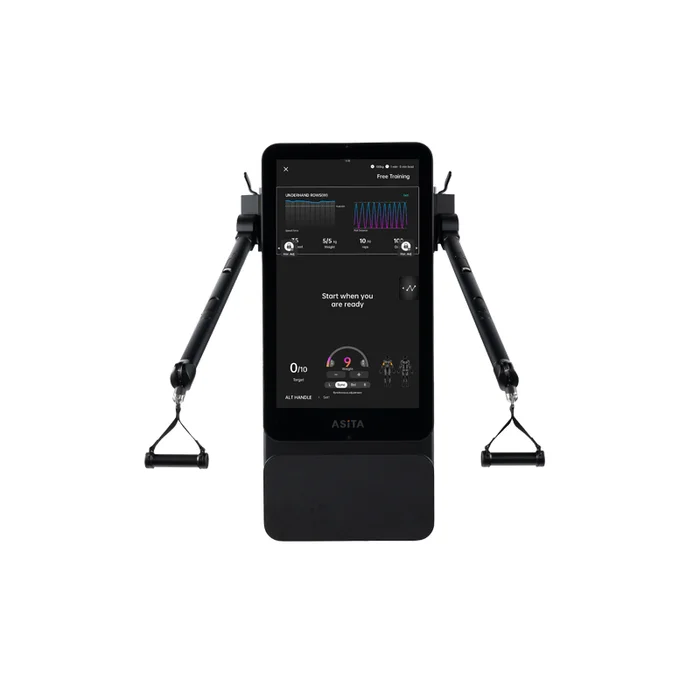
Next, let’s look at the SPlan Model Y by MIROXX. High-quality workmanship and a stylish 24-inch touch mirror, which does, however, take up some space when not in use. The Asita Hunter is similar in design to the TONAL known from the USA and is mounted on the wall to save space. The SPlan Model I by MIROXX, in turn, is a particularly slim wall unit that can be folded flat after training. If you like the space-saving wall-mounted design, you therefore have several options – from the plain Model I to the touch mirror of the Model Y. All in all, the devices can easily be integrated into any living room. Now let’s move on to the winners in this category.
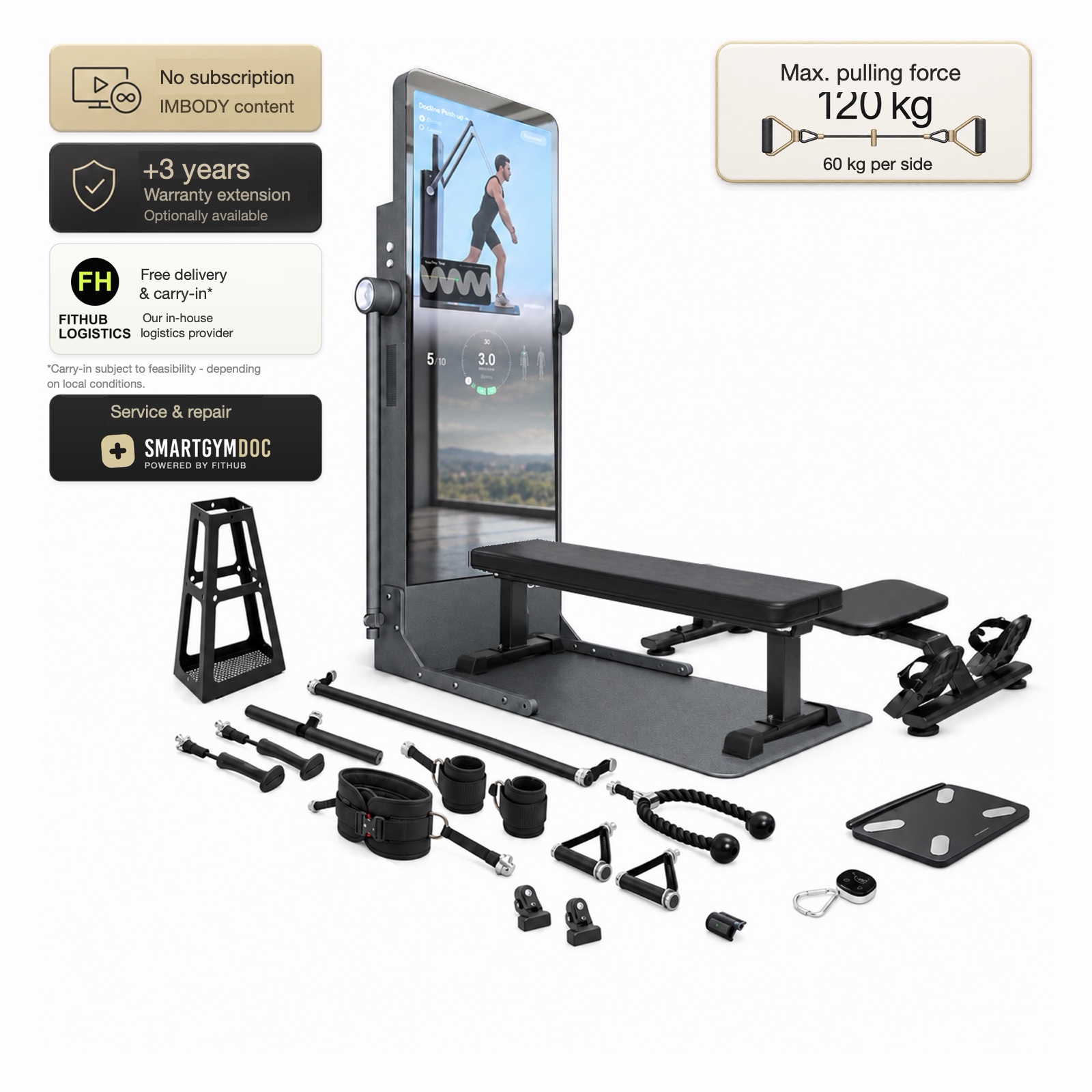
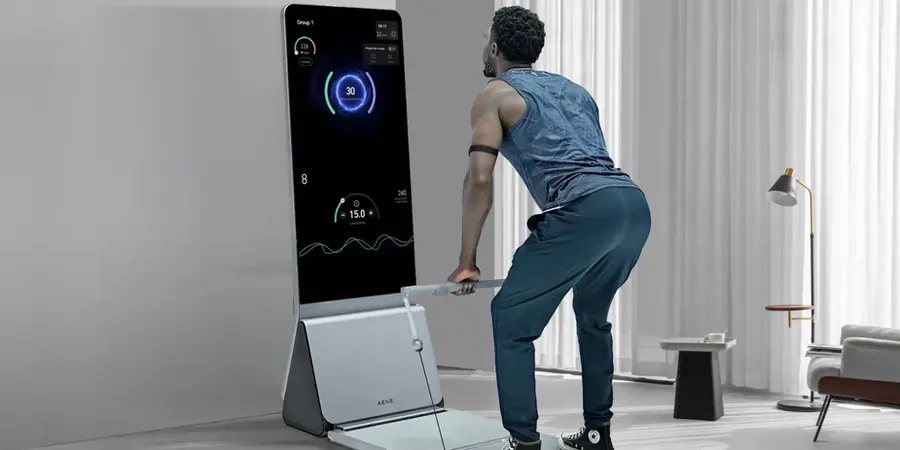
The AEKE K1 and the IMBODY Power S are probably the most attractive of all the smart home gyms available. While the AEKE K1 looks a little more futuristic than the IMBODY, the latter scores points because, like the SPlan Model I by MIROXX and the Asita Hunter, it can be mounted on the wall and does not depend on a protruding floor plate, which makes seamless integration into your own home even easier.
Category 2 – Space requirements
Rank | Manufacturer | Space required (main state) | Type of mounting / use | Training in compact state | Rating |
1 | IMBODY Power S | 0.7 m² (0.1 m² usable) | Freestanding or wall-mounted | Yes | The most space-saving fully functional system. |
2 | SPlan Model I by MIROXX | ≈ 0.5 m² wall area | Wall mounting | Yes | Extremely space-saving thanks to wall mounting, no floor plate. |
3 | Asita Hunter | ≈ 0.5 m² wall area | Wall mounting | Yes | Like the SPlan Model I by MIROXX – wall-based, hardly any floor space needed. |
4 | Speediance | 0.84 m² (0.25 m² folded) | Floor-standing | No | Compact, but no training when folded. |
5 | AEKE K1 | 1 m² (0.3 m² folded) | Floor-standing | Limited | Very small footprint, but not a true strength machine. |
6 | SPlan Model Y by MIROXX | 1.4 m² (0.08 m² folded) | Floor-standing | No | Touch mirror; space-saving on the wall, freestanding in the room with a floor stand. |
7 | sGym Pro | 1.44 m² (0.4 m² folded) | Floor-standing | No | Relatively compact, but folds only for storage. |
8 | Gymera | 2.84 m² (0.53 m² folded) | Floor-standing | Limited | Technically strong, but significantly larger than the competition. |
In this category, too, the IMBODY Power S Pro is clearly in the lead thanks to its two possible installation methods – freestanding or on the wall. Both versions require significantly less space than those of the competitors and even allow full training on just 0.7 square metres, or in the compact version on just 0.1 square metres. This makes the IMBODY Power S Pro the most space-saving fully functional smart gym system on the market.
In second place comes the SPlan Model I by MIROXX, which also takes up extremely little floor space thanks to its wall mounting. With around 0.5 square metres of wall area, it fits perfectly into small rooms while still enabling strength training on the wall – without any floor plate.
Right behind it, in third place, is the Asita Hunter, which is based on the same principle. Here too, the device is fixed to the wall and therefore requires hardly any floor space. Because there is no floor plate, the space underneath remains free, which makes the Hunter a particularly practical solution for space-conscious users.
Fourth place goes to the Speediance Gym Monster. With 0.84 square metres of floor space, it is also one of the more compact systems and can be folded down to 0.25 square metres when needed. However, no training is possible when folded, which somewhat limits its practical use.
Close behind, in
In fifth place comes the AEKE K1. The AEKE K1 requires around one square metre of floor space and can be reduced to a space-saving 0.3 square metres. Even though full strength training is not possible here, the AEKE system impresses with its minimal space requirements and elegant design.
Sixth place goes to the SPlan Model Y by MIROXX, which is installed either on the wall or on a floor stand and, as a touchscreen device, takes up a little more width. With 1.4 square metres in training mode and around 0.08 square metres when folded, it is well suited to functional and strength-oriented training.
In seventh place is the Sportstech sGym Pro, which, as a multifunctional floor station, takes up around 1.44 square metres in use. When folded, the area is reduced to 0.4 square metres, but here too no training is possible in the compact state. Nevertheless, the device remains a solid solution for anyone looking for a stationary strength station with a folding function.
Eighth place goes to the Gymera Smart Home Gym. Despite its impressive technical features and AI-supported training functions, it takes up the most space at 2.84 square metres. Although it can be reduced to around 0.53 square metres when folded, training is only possible to a limited extent in this state.
In summary: the IMBODY Power S Pro sets new standards with its minimal space requirements and full training functionality. The SPlan Model I by MIROXX and the Hunter follow close behind with clever wall-based concepts – but none of them manages to combine as much performance in as little space as the IMBODY Power S Pro.
Category 3 – Set-up
If local conditions allow, i.e. if you have concrete or brick walls and you are not afraid to pick up a drill, wall mounting is certainly the best option for setting up a smart gym in terms of device stability and the enormous space savings. However, many of our customers prefer the freestanding version, either because the intended location is on a drywall that does not offer the necessary stability or because they simply do not like drilling into their walls. With the Asita Hunter, things quickly become somewhat more expensive: although a freestanding option in the form of a floor plate stand is available, it is quite large and heavy, which means that the transport costs alone are immense. On top of this comes the RRP of this application, which ranges between 500 and 1,500 EUR depending on the manufacturer. The AEKE K1 scores points here with an electrically folding floor plate, in theory at least, as it is questionable how prone to faults this mechanism is. Should problems ever occur here, the smart home gym can quickly become unusable.
The Sportstech sGym Pro, the Speediance Gym Monster / Gym Monster 2 and the Gymera come with a folding, but mechanical, floor plate. The SPlan Model Y by MIROXX can either be mounted on the wall or stand freely in the room on a floor stand; the SPlan Model I by MIROXX is fixed to the wall and folded flat after training. The Sportstech sGym, the Speediance product line and the Gymera simply fold the floor plate up by 90°. The Gymera goes even a step further, as the floor plate adapts to the ergonomic design of the base in the folded-up position and becomes a mirror. However, if you feel a little uneasy about standing on a mirror while training, you are certainly not alone.
Speediance and the sGym look very similar. Setting up the sGym probably takes 2-3 more steps for the pull-up bar and the dip handles, but that should not be a big challenge. In principle, all smart home gyms come pre-assembled and you only have to assemble the training benches or any rowing benches supplied with a few screws. The same goes for the IMBODY Power S. What is special here is that it is the only smart home gym system where, if you want to use it freestanding and therefore install the floor plate, the floor plate cannot be folded up. In return, at a height of just 0.6 cm, it is the lowest of all the floor plates, and robot vacuum and mop cleaners have no problem climbing onto it and cleaning it. Conversely, however, this makes moving the IMBODY later on somewhat more difficult in principle than, for example, the Speediance, the AEKE K1 or the sGym, which come with integrated transport wheels and can be rolled into a corner when folded.
As set-up really depends on individual customer needs, it is genuinely difficult to name a winner in this category. With that in mind, here is a quick overview of everything once again:
Summary:
Wall mounting (IMBODY, Hunter, SPlan Model I by MIROXX) is the most space-saving and stable option – ideal with concrete or brick walls.
Freestanding versions make sense if drywalls do not provide stability, but are often heavier and more expensive.
Mechanical folding systems (Speediance, sGym, Gymera) offer flexibility, but cannot be used, or can only be used to a limited extent, when folded.
Electric systems such as the AEKE K1 look elegant, but carry a risk of failure.
The IMBODY Power S Pro impresses with its flat, fixed floor design – the most stable and lowest-maintenance system in the test.
Category 4 – Resistance and motor technology
Analysing the current smart gym systems reveals clear differences in motor power, resistance characteristics and training behaviour.
What matters for the actual training feel is not just the maximum resistance, but also how evenly and stably the resistance is maintained throughout the entire movement – especially on the return.
At the top is the IMBODY Power S, which works with two 750-watt servo motors and reaches a maximum resistance of 120 kilograms.
The servo technology ensures an even, linear resistance curve across both phases of movement – i.e. both concentric and eccentric.
This creates a training feel that comes very close to a classic gym cable machine. In addition, both cables can be coupled via a connector, so the device can also be used bilaterally via a single pull point.
The only small drawback: the servo motors are slightly audible under load, which is due to the technology but unproblematic.
In the upper performance range is the Speediance Gym Monster, which works with two 800-watt magnetic motors and offers a maximum resistance of 100 kilograms (Gym Monster and Gym Monster 2; the 2S and 3 versions reach 120 kilograms).
The device delivers solid performance, but – as with many magnetic drives – there is a noticeable drop in resistance on the return. This means that the resistance is lower in the return phase than in the pull, which can be noticeable during controlled movements.
The Sportstech sGym Pro is also in the upper performance range, likewise reaching a maximum resistance of 120 kilograms.
Both cables can be connected to each other, which enables bilateral exercises.
As magnetic motors are also used here, the device behaves similarly to the Speediance: a slight decrease in pulling force on the return.
Overall, the training feel is powerful, but less even than with servo systems.
The Asita Hunter offers a maximum resistance of 100 kilograms and relies on two 750-watt magnetic motors. The pulling behaviour is smooth and quiet, but the resistance on the return also drops noticeably. This makes the eccentric part of the movement less demanding, which makes training more pleasant for some users but less effective for others.
The AEKE K1 reaches a maximum resistance of 100 kilograms and uses a 750-watt VBT motor, about which little is known so far. Due to the similar technology, however, it can be assumed that its training behaviour is comparable to the Speediance systems – i.e. powerful in the pull, but with slight relief on the return.
The SPlan Model Y by MIROXX works with an in-house developed dual-motor system and offers a maximum resistance of 100 kilograms, adjustable in increments of 100 grams. The device is characterised by quiet, even pulling behaviour and, with four training modes, also covers eccentric training.
The SPlan Model I by MIROXX is the entry-level wall unit and offers digital resistance of up to 50 kilograms via a 425-watt magnetic motor.
The pull feels quiet and pleasant, and the resistance can be adjusted in 1-kilogram increments. This is sufficient for getting started, strength endurance, rehab and unilateral training; if you want to train consistently in the upper strength range, choose one of the more powerful systems.
Finally, the Gymera Smart Home Gym offers a maximum resistance of 100 kilograms with a motor output of around 1400 watts.
Due to a lack of detailed information on force control and transmission, its behaviour cannot be conclusively assessed here.
In summary:
Systems with servo motors – such as the IMBODY Power S – deliver the most stable and realistic resistance curve, as they regulate the force precisely in real time.
Magnetic motors allow high resistance in a compact design, but measurably lose force on the return.
Which system is right ultimately depends on individual goals:
If you value realistic strength training, you will prefer servo technology.
If, on the other hand, you want quiet, gentle training or higher maximum loads, you will find a good alternative in the magnet-based systems.
Category 5 – Training quality
In the training quality category, the eight smart gym systems are assessed on the basis of four main areas:
training content, operation and app integration, hardware and feel, and mechanics and pull points. The aim of this analysis was to assess the systems not on the basis of marketing promises, but on real training practice.
Part 1 – Content & training experience
The IMBODY Power S offers over 350 workouts and over 320 video classes.
A voice guide is not currently integrated, but an upgrade has been announced.
The device has five training modes and receives software updates once a quarter.
No subscription is required; the monthly costs are zero euros.
The language is German (English, French and Italian can be selected as options), and the translation quality is stated as very good.
AEKE K1 has 200 classes and 320 workout videos.
A voice guide is integrated, as are five training modes.
There is no information on update intervals.
There is no subscription; use is free of charge.
The language is English; there is no information on translation.
Asita Hunter includes 180 classes and 275 workout videos.
A voice guide is integrated.
The device offers six training modes and receives quarterly updates.
No subscription is required.
The user interface is partly in German, partly in English.
The translation quality is described as moderate.
SPlan Model Y by MIROXX offers over 220 exercises in the app; no fixed number of classes is specified.
A voice guide is not integrated.
Four training modes are available.
No subscription is required.
The system is available in German, and the translation quality is very good.
sGym Pro by Sportstech has 400 workout videos; there is no information on classes.
A voice guide is not integrated.
There are four training modes, and regular updates are carried out.
A subscription is required; the monthly costs are 10.99 euros.
The language is English; no information on translation is available.
Gymera offers around 1,000 workout videos; there is no information on classes.
A voice guide is integrated.
There is no information on training modes and updates.
No subscription is required; the language is English.
SPlan Model I by MIROXX offers hundreds of exercises via the app; no fixed number of classes is specified.
A voice guide is not integrated.
The device has four training modes.
There is no subscription model, the language is German, and the translation quality is very good.
Speediance Gym Monster includes 60 classes and 370 workout videos.
A voice guide is integrated.
The device offers four training modes; there is no information on updates.
An optional subscription is available; the monthly costs are 29.99 euros.
The language is German; the translation quality is described as unusable.
Part 2 – Operation, control & app integration
Here we compare the control options and technical interfaces of the devices.
IMBODY Power S has three Bluetooth controllers that can be individually assigned.
The connection quality is rated with a grade of two.
App integration is available, Mirror Cast is supported, and you can create your own training plans.
There is no 3rd-party connectivity.
AEKE K1 also uses three Bluetooth controllers.
There is no information on connection quality.
An app is available; Mirror Cast is not supported.
You can create your own training plans; there is no connection to third-party providers.
Asita Hunter uses three Bluetooth controllers.
The connection quality is rated with a grade of three.
An app is available, Mirror Cast is not supported, but there is limited Spotify integration.
Custom training plans can be created; there is no third-party connection.
Gymera uses a Bluetooth controller with voice control.
There is no information on connection quality.
An app is available; Mirror Cast is not supported.
Custom training plans can be created; there is no third-party connectivity.
sGym Pro uses a Bluetooth controller.
No data is available on connection quality.
No app is specified, and Mirror Cast is not supported.
An Apple connection is available; custom training plans cannot be created.
SPlan Model Y by MIROXX is controlled via a Bluetooth controller and the 24-inch touchscreen.
App connectivity via the FITVYR® Coach App is available.
Custom training plans can be created.
SPlan Model I by MIROXX is controlled via the 2.1-inch rotary dial, a Bluetooth controller and the app.
App connectivity via the FITVYR® Coach App is available.
Custom training plans can be created.
Speediance Gym Monster uses a Bluetooth ring as its control element.
The connection quality is rated with a grade of three.
No app is integrated.
Mirror Cast is not supported, but there is a connection to Apple Music.
Custom training plans can be created.
Part 3 – Hardware & feel
In the hardware and feel section, we compared the physical equipment, stability and build quality.
IMBODY Power S has a 43-inch display, no integrated camera and no user weight limit.
The machine weighs around 160 kilograms including the base plate.
Stability is stated as very stable, and build quality as high.
SPlan Model I by MIROXX is operated via a 2.1-inch LCD rotary dial, has no integrated camera and weighs around 31 kilograms.
Stability is described as very stable, and build quality as high.
AEKE K1 has a 43-inch display, an integrated camera and no user weight restrictions.
The system weighs 77 kilograms and is considered stable and well built.
Gymera has a 27-inch display, an integrated camera and no user weight restrictions.
The machine weighs 178 kilograms and is very stable and well built.
Asita Hunter has a 32-inch display with an integrated camera and no weight restrictions, and weighs around 80 kilograms.
Stability is described as very stable, and build quality as average.
sGym Pro offers a 21-inch display and no integrated camera, and allows a user weight of up to 200 kilograms.
The machine itself weighs 115 kilograms.
Stability is rated as stable, and build quality as average.
Speediance Gym Monster has a 21.5-inch display and no camera, and allows a user weight of up to 150 kilograms.
The machine itself weighs 78 kilograms.
Stability is described as unstable, and build quality as average.
SPlan Model Y by MIROXX has a 24-inch Full HD touchscreen with a mirror surface and no integrated camera, and weighs around 78 kilograms without the floor stand.
Stability is described as stable, and build quality as high.
Part 4 – Mechanics & pull points
The last section covers the mechanics and the number of available pull points.
Asita Hunter offers 2×6×5 pull points.
SPlan Model Y by MIROXX offers two training arms that can be adjusted to 5 heights and 7 angles (21 training options according to the manufacturer).
SPlan Model I by MIROXX has one training arm that can be adjusted to 5 heights and up to 5 angles.
IMBODY Power S is equipped with 2×7 pull points.
sGym Pro has 13 pull points.
Speediance Gym Monster has 11 pull points.
AEKE K1 offers one fixed pull point.
No information on pull points is available for Gymera.
Category 6 – Accessories
The next section deals with a topic that is often underestimated but is decisive for training comfort in everyday use: accessories.
After all, regardless of motor power or software, it is the available equipment that determines how versatile a smart gym system really is in use.
We looked at which accessories are included in the basic package, which extensions are available as options, and which manufacturers keep their range rather limited. The more accessories included in the scope of delivery, or at least available as add-ons, the higher the rating.
First place here goes to the IMBODY Power S.
With a total of 28 points, it offers the widest range of accessories, both in the basic package and as options. In addition to standard components such as a training bench, rowing bench, barbell and triceps rope, it also includes less commonly offered extensions, such as a base plate, Bluetooth controller, a yoga mat, bar pads, J-hooks, a body scale and even a digital measuring tape. There are also two special connectors that allow the use of third-party handles or two-sided training via a shared pull point. A range of accessories that is currently unique in this form.
In second place comes Speediance with 26 points.
The system also offers many accessories, including a folding training bench, rowing bench, triceps rope, rowing bar and Bluetooth ring controller.
A base plate, hip belt and a yoga mat are also included or available as options. Speediance proves versatile here, even if the focus is somewhat more on rowing and cardio.
Third place goes to the Sportstech sGym Pro.
With 25 points, it has solid basic equipment and several optional extensions. Items available in the scope of delivery or as accessories include a rowing bench, barbell, triceps rope, a yoga mat and a dip bar.
The range of accessories seems somewhat more fragmented, but still covers many areas of training.
In fourth place there are three systems – Gymera, the SPlan Model Y by MIROXX and the Asita Hunter – each with 18 points.
The Gymera scores with decent basic equipment, including a training bench, rowing bar, triceps rope and optional yoga mat.
The SPlan Model Y by MIROXX comes with an adjustable training bench in the scope of delivery, plus training handles, foot and hand straps, triceps rope, short bar and barbell – solid basic equipment for classic full-body training.
The Asita Hunter also offers a solid package with rowing bench, barbell, rowing bar and base plate – functional overall, but with somewhat less potential for expansion.
In seventh place is the SPlan Model I by MIROXX with 17 points.
As an entry-level device, its basic equipment is deliberately lean; a training bench is not included in the scope of delivery, but the matching SPlan Storage Bench by MIROXX is available as an accessory. The system relies more on a minimalist concept than on a wide range of accessories.
Last place, as expected, goes to the AEKE K1.
With only 14 points, it offers the smallest range of accessories.
However, this is in the nature of the system:
As the AEKE K1 has only a single pull point, many classic extensions – such as additional handles or adapters – are simply not technically necessary or useful. The system is aimed at space-saving, compact training, which at the same time means that the variety of accessories remains limited.
Overall, this comparison shows how much the systems differ in their scope of delivery. While machines such as the IMBODY Power S and Speediance can replace a complete home gym, systems such as the AEKE K1 or the SPlan Model I by MIROXX focus more on a minimalist concept.
Which option suits best ultimately depends on personal training goals and the space available.
Category 7 – Further features
In this category, we look at the special functions and unique selling points of the individual smart gym systems.
The aim here is not to assess the quality of the features, but simply to see which systems offer the greatest range of functions.
First place goes to Gymera with a total of five documented special features.
The system has integrated voice control, detects incorrect movement patterns, also offers a nutrition plan and currently has the most mature gaming section of all manufacturers.
In addition, a camera is integrated that can be used both for live gaming and for taking pictures.
In second place is the IMBODY Power S with a total of two and a half points.
Its special features include freely assignable Bluetooth controller buttons, an open course library that will be available soon, and the announced integration with the IMBODY WalkingPad and the IMBODY Spinning Bike.
This makes the IMBODY Power S one of the best-connected systems on the market.
Third place is shared by three manufacturers – AEKE K1, the SPlan Model Y by MIROXX and the sGym Pro – each with two documented features.
The AEKE K1 offers exercise and movement analysis using an integrated camera, as well as a stretching control function.
The SPlan Model Y by MIROXX combines the 24-inch touch mirror with a dual-motor system and an adjustable training bench included in the scope of delivery.
The sGym Pro has integrated pull-up and dip handles and also offers access to additional digital content via an optional subscription.
In sixth place are three more systems – the SPlan Model I by MIROXX, the Asita Hunter and Speediance – each with one documented feature.
For the SPlan Model I by MIROXX, this is the 2.1-inch rotary dial with Bluetooth controller, which can also be used to adjust the resistance during the exercise.
The Asita Hunter offers the option of individually adjusting the training intensity within the training mode.
And with Speediance, the subscription unlocks additional digital content that expands the range of training.
The comparison therefore shows:
Some manufacturers focus on a high level of technological connectivity and gamification, while others see their strengths in simplicity and clear training functionality.
Which approach is the right one ultimately depends on the user's individual training goals and personal preferences.
Category 8 – Costs
In this category, we compare the eight smart gym systems both by their pure price and by what they actually offer in relation to their functions, equipment and training quality.
All previous rating categories were taken into account: training quality, accessories, range of functions and special features.
Let's start with the pure price comparison, i.e. the question: Which system is the cheapest to buy?
The sGym Pro comes out as the most affordable, closely followed by the Asita Hunter and the AEKE K1.
With an entry price from €2,499, the SPlan Model I by MIROXX is one of the more affordable systems, while Speediance and the IMBODY Power S are already in the upper price segment.
The most expensive systems are the Gymera and the SPlan Model Y by MIROXX, which, as a professional device with a 24-inch touch mirror, is in the upper price segment.
However, if you look at value for money, i.e. the question of where you objectively get the most for your money, a different picture emerges.
Here the IMBODY Power S takes first place.
It impresses with its high training quality, the most extensive accessory package and above-average technical equipment that still seems justified even in higher price segments.
In second place comes the sGym Pro, which offers solid overall performance despite its low entry price.
It offers many training options, decent stability and a respectable selection of accessories, making it an attractive choice in the mid-price segment.
Third place goes to the Gymera, which scores with its range of functions – in particular voice control, motion detection, camera and gamification features.
This technical variety partly offsets the higher purchase price.
In the middle of the field are the AEKE K1, the Asita Hunter and the Speediance.
While AEKE and Asita are attractively priced, users have to accept minor compromises in translation, connectivity and range of functions.
Speediance, on the other hand, offers good performance, but with a subscription model that increases running costs.
The two SPlan devices are positioned differently: as the most affordable entry-level device, the SPlan Model I by MIROXX offers well-balanced value for money for anyone who wants to train solidly with up to 50 kg.
As a professional device, the SPlan Model Y by MIROXX is priced higher, but in return offers 100 kg from two motors, a 24-inch touch mirror and an adjustable bench included in the scope of delivery.
In summary:
With smart gyms, a high price does not automatically mean more performance.
While the IMBODY Power S offers the best overall value, systems such as the sGym Pro prove that convincing performance is also possible in lower or mid-range price brackets.
Ultimately, what matters is whether the buyer values the most realistic training feel possible, additional digital functions or particularly good value for money.
Category 9 – Customer service
In this category, we look at whom customers can contact when they need service and where the respective company or sales partner is based.
A simple rating system applies here:
All manufacturers based in Germany or with direct distribution in Germany take first place, as they can guarantee fast, German-language and legally secure communication. Manufacturers based abroad follow in second place.
In first place are no fewer than six systems, all of which have their headquarters or official sales partner in Germany:
IMBODY Power S, SPlan Model I by MIROXX, Asita Hunter, SPlan Model Y by MIROXX, sGym Pro and Gymera.
The IMBODY Power S is sold by FITVYR®, a Germany-based company that offers direct and fast customer support.
The Asita Hunter also falls into this category, as it is likewise supported by FITVYR®.
The SPlan Model I by MIROXX is sold in Germany through FITVYR® and therefore offers direct, local contacts.
The SPlan Model Y by MIROXX is also sold and supported in Germany through FITVYR®.
The manufacturer Sportstech, known for the sGym Pro, is a German company with an established customer service and extensive service experience in home fitness.
Gymera, available through Fitshop, also benefits from the German dealer network and several physical stores, which is a clear advantage when service is needed.
In second place are the two systems Speediance and AEKE K1.
Speediance does not maintain a German service centre, which can make direct contact more difficult and lead to longer processing times, particularly for spare parts or returns.
There is also no German service centre for the AEKE K1.
This means that users have to rely on international support if problems arise – with the corresponding communication hurdles and delivery times.
In summary:
If you place particular value on fast response times, easy communication and legal certainty, a provider based in Germany gives you a clear advantage.
The difference becomes noticeable at the latest when a technical problem or a warranty case occurs.
Category 10 - Future-proofing
One point that plays a decisive role for many customers is the question of how future-proof the manufacturers are.
After all, smart gyms are high-value investments – and the justified concern of many buyers is: Will the manufacturer even still exist in a few years?
Of course, this question cannot be answered with absolute certainty. Nevertheless, there are some clear facts that give an impression of how solidly the individual companies are currently positioned and how fit they are for the future.
IMBODY, Speediance and AEKE are considered financially very sound.
All three companies have a stable capital base and international investors.
In the case of AEKE, it is known that a major mobile phone manufacturer is behind the company.
The company has also completed several successful funding rounds, which suggests strong confidence among its investors. Speediance has also been able to attract significant investors in recent years. What is worrying, however, is that both Speediance and AEKE are currently investing enormous sums in marketing and advertising. Such aggressive advertising budgets can generate growth in the short term, but in the long term they carry the risk that the company will never become lastingly profitable.
Whether these are sustainable business models remains to be seen.
Asita is a rather small company by comparison.
However, this need not necessarily be a disadvantage – smaller structures can also mean more flexibility. Especially when production and service are organised efficiently, a smaller provider can also remain stable in the long term.
Sportstech, the manufacturer of the sGym Pro, is considered financially sound and well established.
The company has proven itself in the home fitness market for years and has a broad product range. However, it is questionable whether the smart gym segment will remain interesting enough for Sportstech in the long term. As the company does not focus exclusively on this product line, it is unclear whether the sGym Pro will be developed further in the long term or eventually be taken off the range.
Spare parts and support should, however, remain available for many years to come.
By contrast, little is known about Gymera.
The only official sales partner is Fitshop, a renowned fitness retailer in Europe. At first glance this speaks for its reliability, but it does not allow any firm conclusions about the future viability of the manufacturer itself.
Whether Gymera can hold its own in the market in the long term therefore remains open.
The SPlan Model I by MIROXX and the SPlan Model Y by MIROXX come from the manufacturer SPlan and are made under the MIROXX brand.
Production is running steadily, and both devices are a permanent part of the FITVYR® range.
As a German retailer, FITVYR® handles advice, sales and service – a direct, reliable point of contact for both models.
Overall, the picture is this:
Some manufacturers are financially broadly based and strategically well positioned, while others are still at the beginning or depend on sales partners.
For buyers, this means:
If you value long-term security, you should look not only at the quality of the machine, but also at how financially stable the company behind the product is.
Overall rating – smart home gym comparison 2026
After analysing all ten rating categories, the following overall picture emerges of the smart home gyms currently available on the market.
The ranking takes into account technical performance, training quality, range of accessories, ease of use, value for money, service availability and future-proofing.
The result shows that the systems differ significantly – both in concept and in the strategic direction of their manufacturers.
1st place – IMBODY Power S Pro
The IMBODY Power S Pro impresses in almost all rating categories.
It combines a realistic pull feel with versatile training modes, high-quality workmanship and an excellent range of accessories.
Particularly noteworthy are the modular connectivity with other IMBODY products such as the WalkingPad and the Spinning Bike, and the open-source training platform, which will allow even more personalisation in future.
The training quality is at the highest level, customer service is based in Germany, and the company's future is considered stable.
Even though the price is in the upper mid-range, no other system currently offers a better overall package of function, quality and security.
2nd place – sGym Pro (Sportstech)
The sGym Pro positions itself as a strong all-rounder with good value for money.
It offers numerous training modes, solid motor performance and a wide range of accessories.
A particular plus is the German support from Sportstech, which ensures a long-term supply of spare parts.
Although the software is not quite as intuitive as on the IMBODY, the machine clearly scores in terms of stability, versatility and availability.
Future-proofing is considered high, although it remains open whether Sportstech will keep the model in its portfolio permanently.
3rd place – Gymera
Gymera impresses with innovation: voice control, motion detection, an integrated camera and gamification make the system technically exciting.
The training quality is solid, and the price is in the mid-range.
However, little is known about the manufacturer itself, which raises questions about long-term availability.
As it is sold through Fitshop, stable customer access is at least ensured.
Technically, Gymera offers a lot, but organisationally an element of uncertainty remains.
4th place – Asita Hunter
The Asita Hunter is a compact, functionally strong machine with clean motor performance and a pleasantly quiet pull.
The training quality is good, the accessories are solid, and customer service via FITVYR® in Germany is reliable.
Weaknesses lie in the software translation and the audio guide, which is partly in English.
Financially, the company is stable, but considerably smaller than the large international competitors.
Overall, a recommendable system for users who value functionality and service.
5th place – SPlan Model Y by MIROXX
The SPlan Model Y by MIROXX is a high-quality professional device with a 24-inch touch mirror, two motors and up to 100 kg of digital resistance.
An adjustable training bench is included in the scope of delivery, the build quality is high, and it is sold through FITVYR® in Germany.
In the overall ranking, it is in the upper middle of the field: performance, equipment and the German service through FITVYR® are offset by a higher purchase price from €9,499.
For demanding private customers, studios, physiotherapy and personal training, however, it is technically one of the strongest systems in the comparison.
6th place – AEKE K1
The AEKE K1 looks modern and is technically advanced.
With motion detection and stretching control, it brings interesting features aimed at AI-assisted training.
The hardware is solid, and the price level is fair.
However, there is no German user interface and no local support.
The manufacturer is financially strong, but its long-term strategy in the European market remains unclear.
Nevertheless, an exciting option for English-speaking users with a focus on technology.
7th place – SPlan Model I by MIROXX
The SPlan Model I by MIROXX is the affordable entry into the world of smart gyms for the wall: clean design, high-quality workmanship and a pleasant, quiet pull feel thanks to the magnetic motor.
With up to 50 kg of digital resistance, it is designed for getting started, strength endurance, rehab and unilateral training, not for maximum strength loads.
As the device is sold and supported in Germany through FITVYR®, service is straightforward.
Overall, a strong value-for-money offer from €2,499 for anyone who wants to train solidly and in a space-saving way on the wall.
8th place – Speediance
Speediance is technically mature and offers many courses and training modes, but falls somewhat behind in stability and durability.
The magnetic motors deliver high resistance, but show a drop on the return.
The dependence on the subscription model and the lack of German support are also weak points.
On the positive side are the strong capital base and the ongoing development of the software.
For users who train in English and prefer cloud-based training, Speediance remains interesting, but it is less attractive for German-speaking customers.
Conclusion
Overall, a clear picture emerges:
While the IMBODY Power S Pro sets the standard in almost all areas, models such as the sGym Pro or the Asita Hunter offer strong value for money with local support.
Gymera and AEKE show the greatest potential for innovation, while the SPlan Model I by MIROXX and the SPlan Model Y by MIROXX cover the spectrum from the affordable wall-mounted entry-level device to the professional device with touchscreen.
Speediance is not entirely convincing technically and suffers from structural weaknesses in support and sustainability.
The future of the smart home gym market will be decided by who manages to combine technology, support and durability in the long term.
Finally, we must point out that, although we are ourselves the exclusive distributors of IMBODY and Asita, we have at all times stuck to verifiable facts from the websites of all manufacturers, review forums and user experiences from social networks. All the information we have provided is publicly available.
So there they are: the 8 smart home gyms available on the German market. In the meantime, we have expanded our portfolio: in addition to IMBODY and Asita, we now also sell SPlan by MIROXX (Model I and Model Y), NordicTrack and VISBODY – all available directly from FITVYR®.
Until then - and every reader can genuinely check this for themselves - the IMBODY Power S Pro is and remains the undisputed test winner among smart home gyms.
As always, we are of course happy to answer any questions you may have, at any time.
Your FITVYR® editorial team.