Training at home in 2026 - what is the best solution?
Training at home in 2026 – what is the best solution?
The home fitness market has changed radically in recent years. What used to consist of a weight bench, a few dumbbells and perhaps a spinning bike has become a highly dynamic, technology-driven ecosystem in 2026. Consumers today face a strategic decision: combine individual pieces of equipment – or opt for integrated, digital all-in-one solutions.
This article puts the available options into context and answers the central question: what is the most efficient, sustainable and economically sensible solution for training at home in 2026?
1. Classic home training: proven but limited
Many households start with classic basics:
Weight bench
Dumbbells or barbell
Spinning bike or elliptical cross-trainer
Advantages
Low initial costs
No subscriptions or software dependency
Highly robust, hardly any maintenance
Disadvantages
High space requirement as equipment grows
No training control or progression logic
Motivation depends heavily on the user
No feedback on training quality
Conclusion:
Still usable for beginners or purists, but not scalable. If you want to make long-term progress, you will quickly come up against structural limits.
2. App-based training without hardware: flexible but ineffective
In 2026, there are a large number of fitness apps that offer workouts with no or minimal equipment.
Advantages
Maximum flexibility
Low costs
Can be used anywhere
Disadvantages
No measurable resistance
No objective performance analysis
Limited muscle building
High dropout rates
Conclusion:
Ideal as a supplement or a way to get started, but not a fully fledged training solution for ambitious goals such as muscle building, body shaping or improving performance.
3. Smart home gyms: the new standard in home training
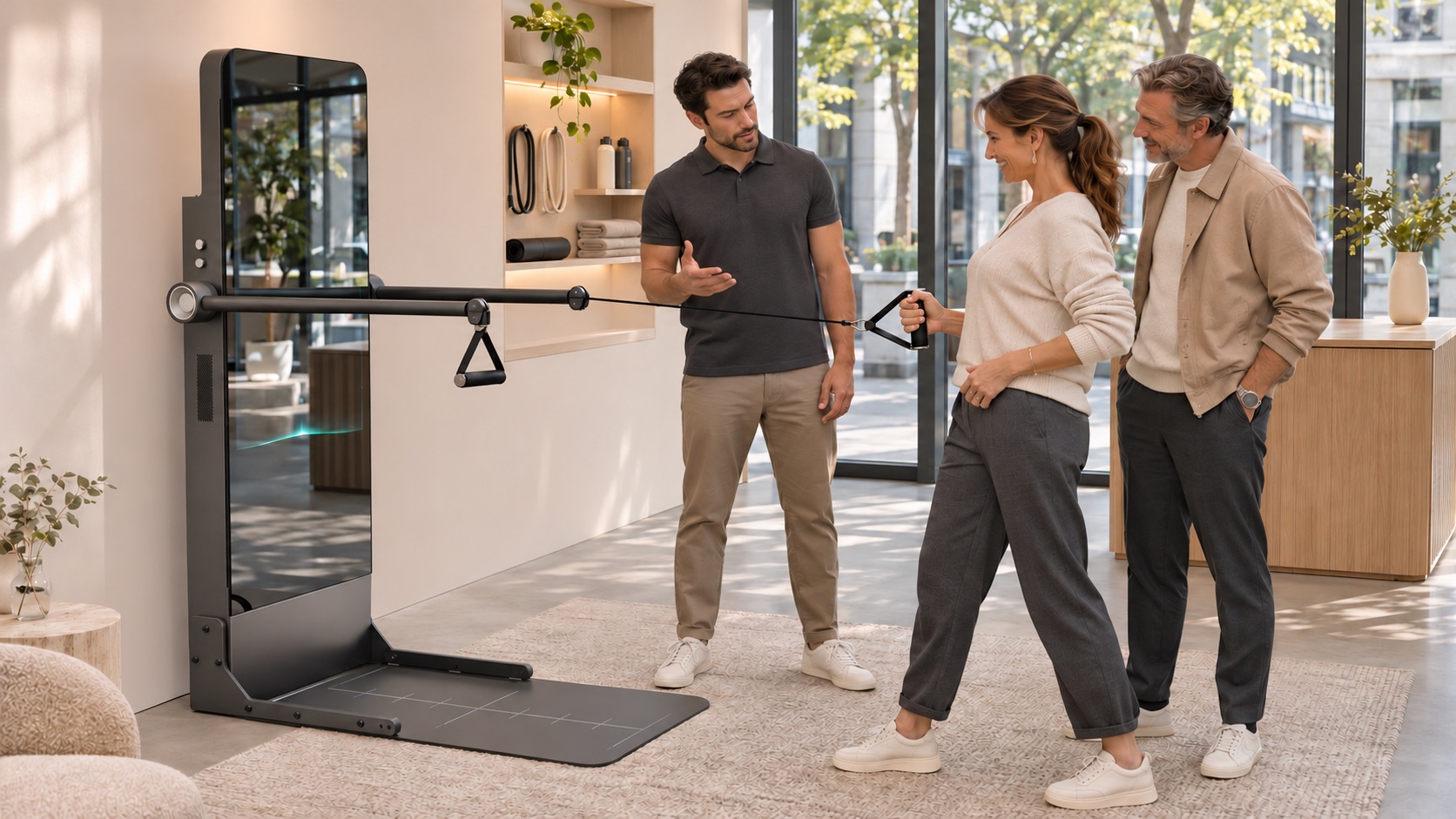
The decisive development of recent years is the establishment of so-called smart home gyms. These systems combine:
digital resistance
integrated screens
AI-supported training control
hundreds of guided workouts
minimal footprint
Today, a modern smart gym effectively replaces a complete gym – while requiring significantly less space.
Key advantages
Precise resistance control instead of changing weights
Automatic adjustment to performance level
Real-time feedback on exercise execution
Several training modes (e.g. eccentric, constant, elastic)
Motivation through structure, programmes and progress tracking
Economic considerations
No membership fees
No travel
Time savings as an additional ROI factor
High resale value for premium systems
4. Space, time, motivation: the three bottlenecks – one solution
The three most common reasons why people give up training are:
1. Lack of time
2. Space problems
3. Lack of motivation
Classic solutions usually address only one of these points. Smart home gyms solve all three at the same time:
Training in 20–40 minutes
Footprint sometimes under 0.2 m²
Structured programmes with measurable results
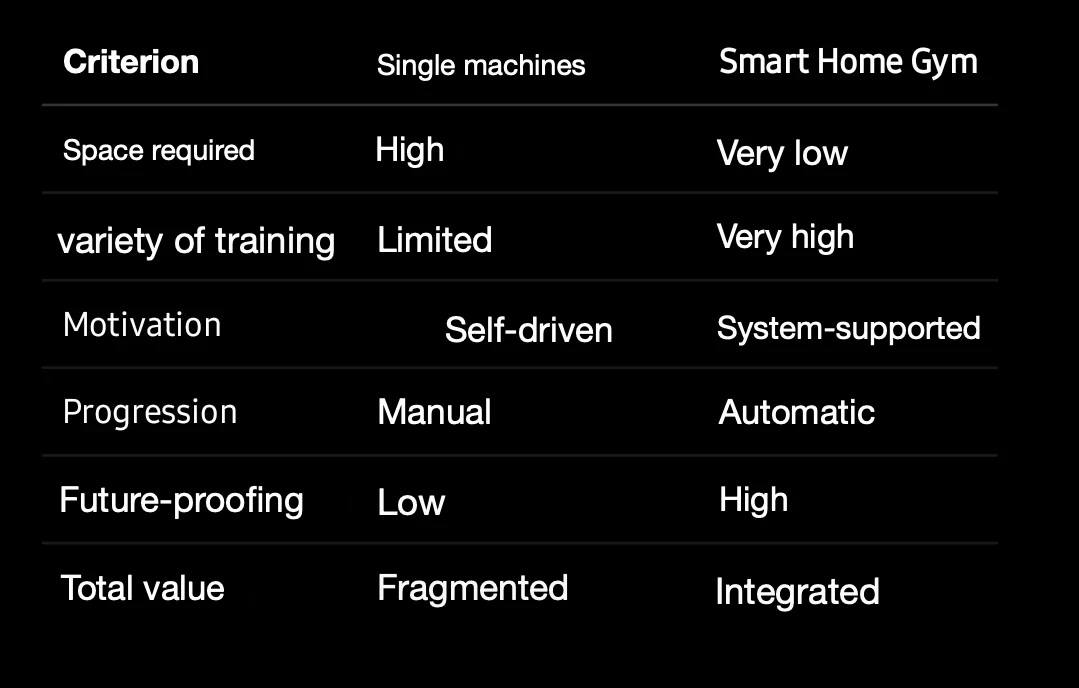
5. The decision in 2026: modular or integrated?
The central question is no longer whether to train at home, but how.
Criterion Individual equipment Smart home gym
Conclusion: the best solution for 2026
Anyone who wants to train at home seriously, efficiently and for the long term in 2026 cannot ignore integrated smart gym solutions. They are not a gimmick but the logical evolution of home training – comparable to the switch from the MP3 player to the smartphone.
Individual pieces of equipment still have their place, but primarily as a supplement or for very specific user groups. For everyone else:
Fewer machines, more system. Less effort, more results.
This is exactly where FITVYR®’s strategic focus comes in: high-quality, space-saving and future-proof training solutions for people who take their time and their progress seriously.